

Curated by Jesse Hopps
Ideas that change how you run commercial transformation.
Each one takes an assumption most large commercial organizations still run on — that people resist change, that training builds capability, that governance makes adoption stick — and shows why it breaks, with the science and the operator proof behind it.
Written to sharpen how you lead the work. Sourced from real operator practice inside the Consortium and Fellowship™ — updated monthly.

The AIRAS Method for Accelerating Transformation
A rollout installs information. AIRAS installs momentum and lasting impact.
AIRAS is the five-stage rhythm a transformation runs on — align, inspire, reflect, apply, scale — each stage built on behavioral science that closes a gap the change-management playbook leaves open. ADKAR names the terms of compliance; the motivational question decides what happens the week after launch.
Read the brief
How to Get Change to Actually Stick
76% of transformations fail. The method itself is the problem.
76% of transformations fail to generate value, and the number has not moved in thirty years of increasingly sophisticated program design. At that rate the method is the problem rather than the execution — which makes it a capital allocation question.
Read the brief
Enterprise Adaptation Is Not a Change Management Problem
Change management failed them. Adaptation is the real problem.
McKinsey puts transformation failure at 70%. BCG at 75%. Bain at 88%. Those are architecture failures rather than execution ones — the design treats behavior as a downstream consequence instead of the primary problem.
Read the brief
Your People Are NOT the Problem
People aren’t resisting. Your system is.
People do not resist change. They resist being changed. Passive resistance has three design causes — an empathy gap, destroyed competence, denied autonomy — and each is a flaw in the system rather than in the person.
Read the brief
The Transformation Architect
Accountable for outcomes, without authority over the people who must change.
Most change leaders climb as far as the Analyst, the Manager, or the Facilitator — real value that stalls once the pressure lifts. The Architect works a level up, engineering the conditions for change without triggering resistance.
Read the brief
The Capability Illusion
A phone call on the way to a weekend away, and the sentence I did not plan to say.
Jesse had built one of the largest content libraries in commercial excellence — a 300,000-member community, 6,589 client organizations, a thousand playbooks — and then told a buyer he did not want to build the thing it was built for. The buyer agreed with him. This is what the two of them worked out afterwards, and what Roy van Griensven built at LANXESS instead.
Read the brief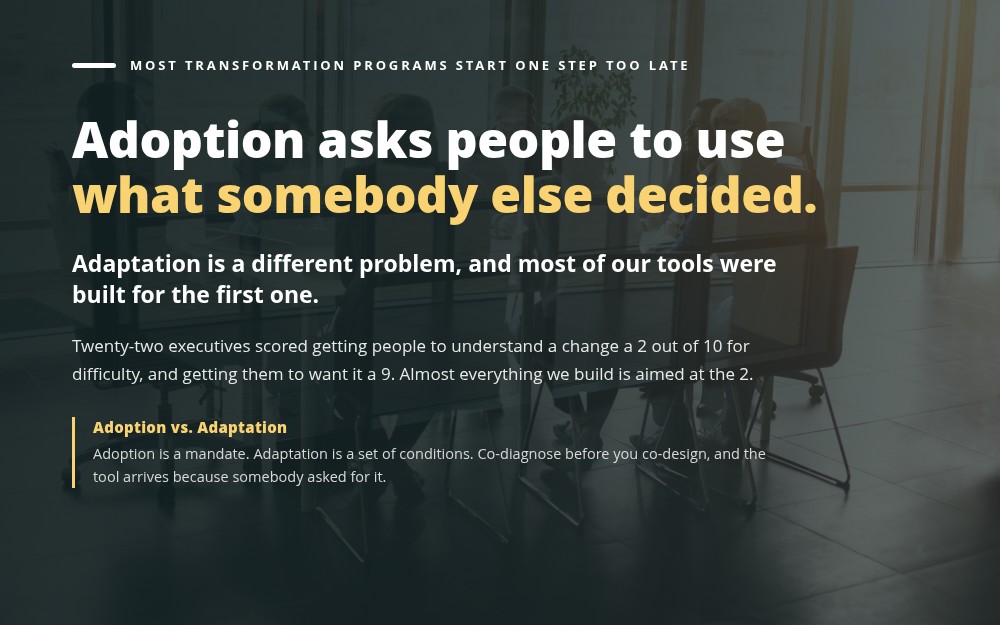
Most Transformation Programs Start One Step Too Late
Adoption asks people to use what somebody else decided.
By the time change management is called in, somebody has already named the problem and picked the answer. Twenty-two executives scored getting people to understand a change a 2 out of 10 for difficulty and getting them to want it a 9 — and almost everything a transformation office builds is aimed at the 2.
Read the briefBy invitation only
The Fellowship
A working circle for Heads of Commercial Excellence, Strategy, Transformation, and Growth at $1B+ enterprises — operators building the next commercial operating model, together.
Want peer-level analysis of ideas like these?
Consortium members discuss these frameworks in the room — with operators who have tested them at $1B–$10B enterprises.