
Accelerating Transformation: From Push to Pull
Twenty-two executives scored the two hardest parts of change: understanding why it is needed came back a 2 out of 10, wanting it a 9. Ninety minutes on that gap — and on the LANXESS work where business units ended up queuing to get on CRM.
Download the slides
In the room
- Host
- Jesse Hopps
- Guest
- Roy van Griensven, Head of Business Transformation & Commercial Excellence, LANXESS
- Room
- Twenty-two executives. Participants from Chase Corporation, Demand Metric, FORVIA HELLA, Glastron, Honeywell, IDS, LANXESS, Medtronic, Pearson, Pfizer, Philips Healthcare, Plaskolite, Restek, Schneider Electric, Stryker and TVH Parts, with four more recently of Electrolux, Roche, SABIC and Solventum
You can push people to adopt a change, or you can build the conditions where they adapt on their own.
Twenty-two commercial leaders on why change programs stall: the part of change nobody struggles with, the part everybody does, and the LANXESS work where nobody rolled the CRM out — people asked for it.
Twenty-two executives, from chemicals and specialty materials, pharma, medical devices, industrial manufacturing, automotive, appliances, education, analytical instruments and parts distribution. About half of them had been trained in ADKAR. It is a good model. It gave everybody a shared language and it moved management thinking a long way. It is just not the full picture, and rather than say that ourselves, we asked the room to build the model for us and score each letter for how hard it is to pull off in a real business.
ADKAR says five things have to be true before somebody changes. They have to see why it is needed, want it, know what to do, be able to do it, and get backed up afterwards. The room scored every letter. Those scores are where the session turned. Roy van Griensven took the second half, with a method he has now run seven times at LANXESS, thirty to forty people at a time.
The short version
- Getting people to see why change is needed is not the hard part. Asked how hard each step is on a scale of 1 to 10, the room put that at 2 and getting people to want it at 9.
- Resistance is about anticipated loss, not about change. The question people ask is not what's in it for me, but what do I have to lose.
- ADKAR explains one person changing. Push it across a whole company and you get a thousand separate cases to manage instead of one change.
- Trust is the input most often skipped, and no amount of communication substitutes for it.
- It is not how many people you convince, it is who. Somebody doing your job saying it helped them beats twenty town halls.
- Ask the people doing the job to work out the problem themselves and they land on the answer you would have handed them anyway, and then they ask you for it.
- Underneath the visible work sit three results: do people move, does the business get better at its job, does any of it turn into growth. Where you land on all three at once is what winning at work means.
Change management is the tip of the iceberg
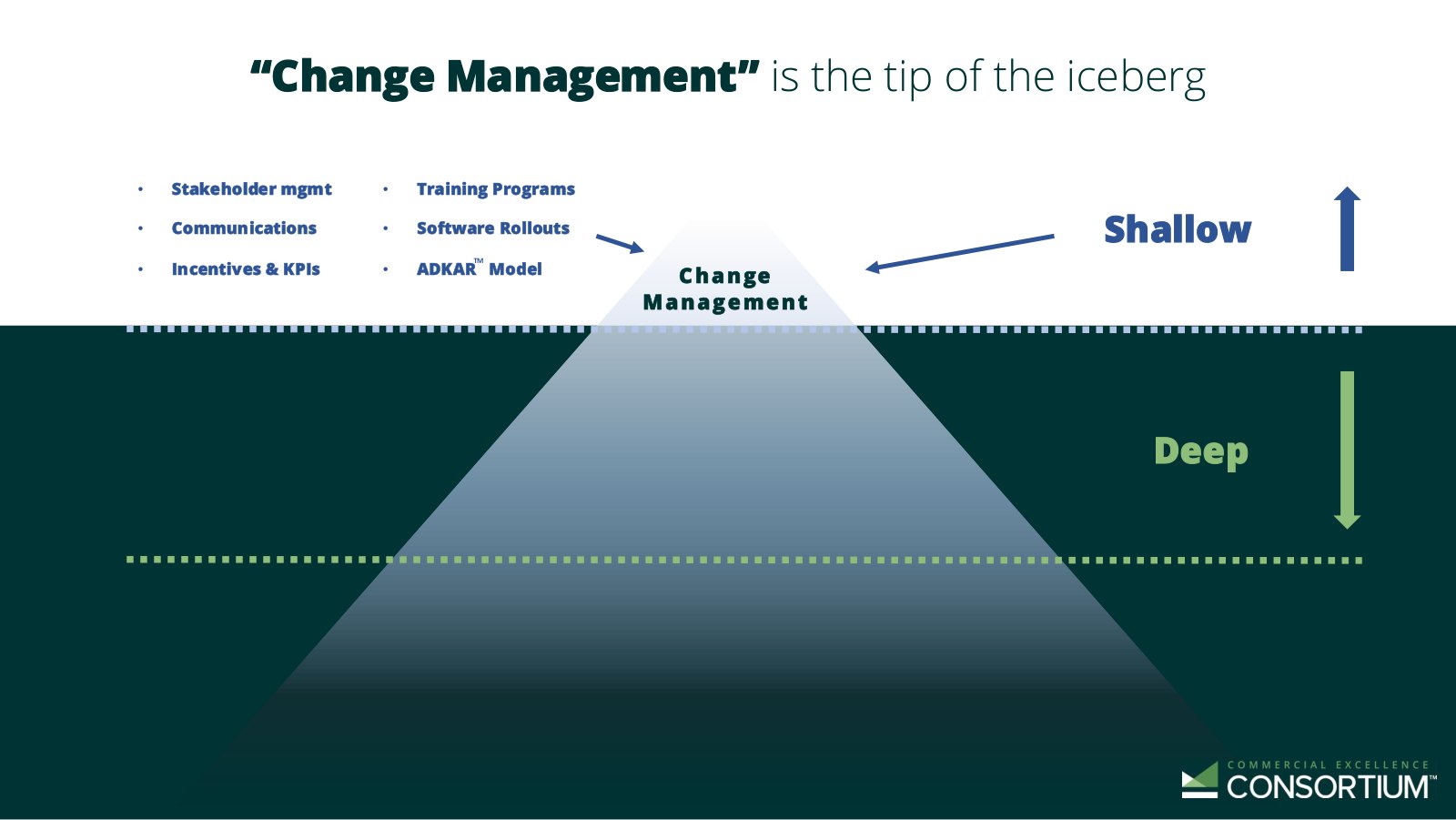
Picture an iceberg. The bit above the water is everything you can see us doing, which is stakeholder maps and comms plans and incentives and KPIs and training and software rollouts and ADKAR itself. It is what gets a budget, it is what gets reported, and it is what most of us get judged on.
None of it is wrong, and that is the whole point of drawing it as a tip and not as a mistake. Every one of those tools does something real, and most of us have spent a career getting good at them. The picture just says that all of it together is the small part above the water, and a program built only out of that is being run off its smallest piece.
Under the line I put three things, and every one of them is an outcome rather than an activity. That is the point of it. Change management is work you do. The bottom half is results you either get or you do not, so the questions are whether people move, whether the business ends up better at its job than it was, and whether any of it turns into growth. And here is the awkward part, because you can finish every single job above the line and still get none of the three.
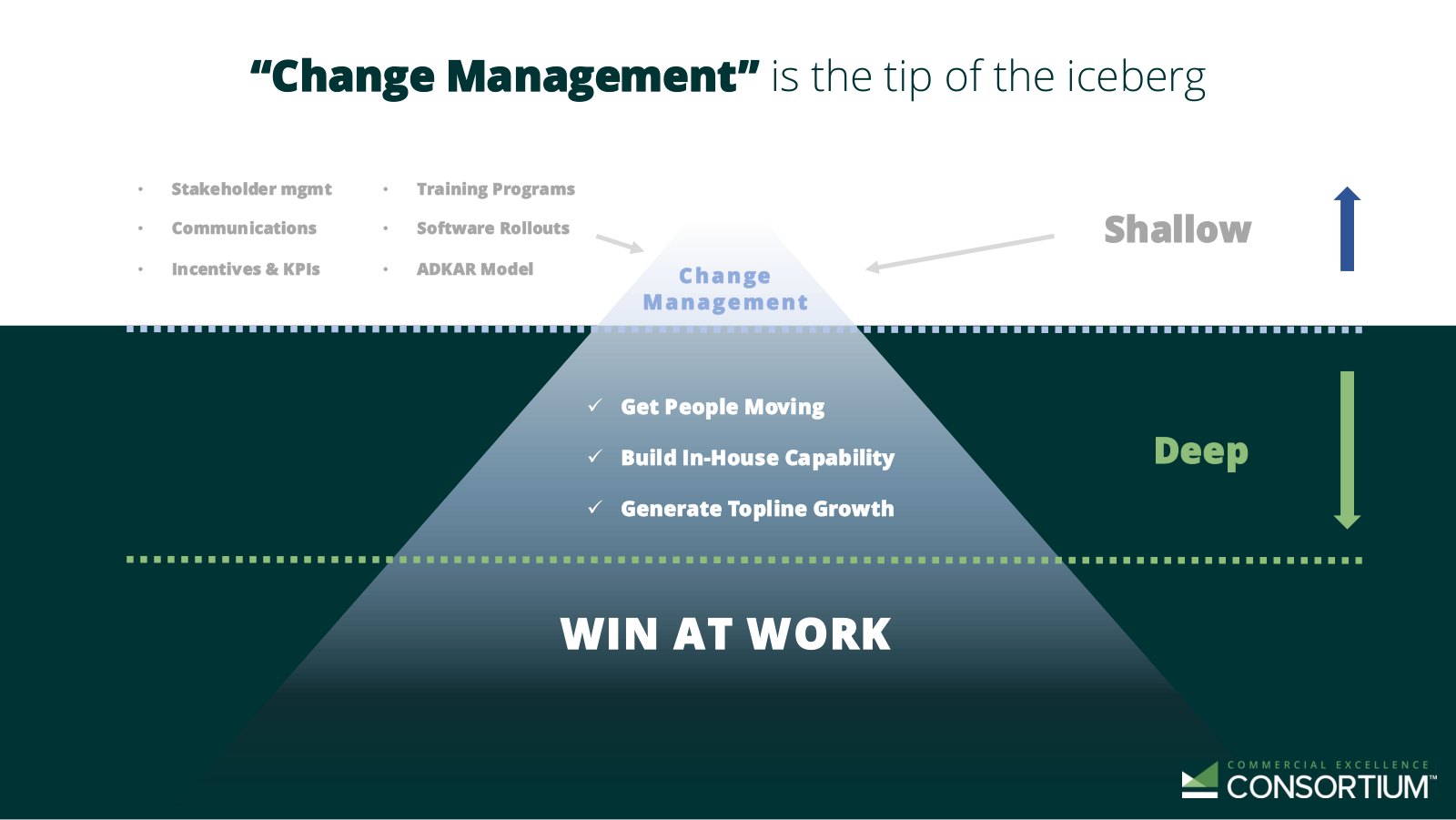
At the bottom is the phrase the three add up to: win at work. Notice that it is about the person doing the job and not about the program, because if you get all three you get promoted, and if you miss them you are looking for a new job, probably the same job somewhere else. That is a different deal than most of us were handed. Not run the change program well. Get the three results that made the change worth doing in the first place.
Then each one is drawn as a slider, not a box you tick. There is no line to cross. Every slider runs from a bottom end nobody would defend up to a top end hardly anyone reaches, and your company is sitting somewhere on all three at once. So it is where you land on all three together that counts. One score, not three separate reports. High on all three is what winning at work means. Anywhere else tells you how far off you are, and which of the three is keeping you there.
The room took the model apart itself
Half the room had been through ADKAR or Prosci training. So rather than explain it, the host asked them to fill it in and score each letter. Nobody argued with the model. It is a good account of what has to be true before one person changes. It just does not tell you why that so rarely happens across a few thousand people.
“It's really great for individual transformation, but it doesn't scale to organizations very well. Everywhere I try to scale it across an organization, I end up with a thousand points of light to manage instead of an overall holistic transformation.”
That came from someone trained in the method, not from a critic, and others hit the same wall on their own. Several now use it for one person or one team, and reach for Kotter or something like it above that. One admission landed harder. Almost nobody in the room had gone and read up on motivation or how people handle change until the last couple of years. The host called that our gap, not the field's.
Awareness is cheap. Desire is the unsolved letter.
Awareness
2
Desire
9
So which letter is the hard one? Look at the gap. Most of what we build goes at the letter the room scored a 2, whether that is town halls or cascades or comms plans, and very little of it goes at the one they scored a 9. Someone put it better in the chat: getting people aware is easy, getting them to see it the same way is not. Someone else named the opposite problem, which is more common than silence: too many burning platforms at once, which buries the message instead of landing it.
Two people put their finger on why the easy letter is not as easy as a 2 makes it sound.
“A lot of companies don't do it well. Don't tell them why we are doing this. And then when they do do it, they create this broad brush awareness. And the problem with desire is they're not messaging to the individual.”
“People do really well at adapting when they know they have to change. If I know I have to change, I change. So it's really about creating the need. We're really good at adapting.”
Which is the whole problem with a CRM rollout. If the world is moving and your job is on the line, you move. But the need is real to the company and not yet real to the person, and that gap is where the adoption plan goes to die.
Resistance is about what people stand to lose
So what are people holding on to? The line that turned the conversation came from the floor, and it was blunt. The question in someone's head is not what is in it for me. It is what do I stand to lose, and what does this change mean for me. Standing, being good at your job, who you know, how much say you have. And we are wired to feel a loss about twice as hard as we feel a win of the same size.
Where the loss gets felt
Anything touching salespeople draws the bad news first, and the room said so in its own words.
“A lot of the commercial excellence initiatives that I've driven are touching salespeople. And there's a little bit too much focus on the negative. Like, I'm going to have to do more things in CRM, or I'm going to have accounts taken from me and given to someone else.”
“It becomes the unequal compact, which is it's either participate or lose your place in the company. And even if you participate, your place in the company is likely to have much higher expectations upon you. So this idea that you can intrinsically find desire may be a false premise in many cases.”
“If we think about the people who observe that every day thousands of people in pharma are fired, and they are told that AI will resolve all these challenges — the motivation of people in the field, what I observe currently, is going down every day. Even if we show them a carrot, they see what's happening.”
He added something nobody else had raised: national culture changes the starting point, and in his market a proposal draws forty reasons why it cannot work before anybody tests it. And the fear underneath it is usually right, not silly.
“I used to be the guy that knew how to use the old legacy system and everyone came to me. Well, what happens when that's all in a database and they can just go ask the AI genie? My value to the company all of a sudden diminishes. And the truth is, it's true.”
The strongest pushback: it is trust, not desire
The sharpest disagreement of the session did not soften the argument. It moved it one layer down.
“We can have this awareness, we can have this desire, but are we building coalitions? Are the right people in the room where it happens? And is that trust there even to create those small cohorts? For me, the biggest element in any change program is not the desire. The desire is there. I think in professional life it's the trust that is the biggest missing element.”
Her point is that everybody already knows change is not a choice. What is missing is whether people believe leadership is listening, whether they get a real say, and whether they are allowed to get things wrong while they learn. That is a list of conditions, not a list of messages.
Outcome one — getting people moving
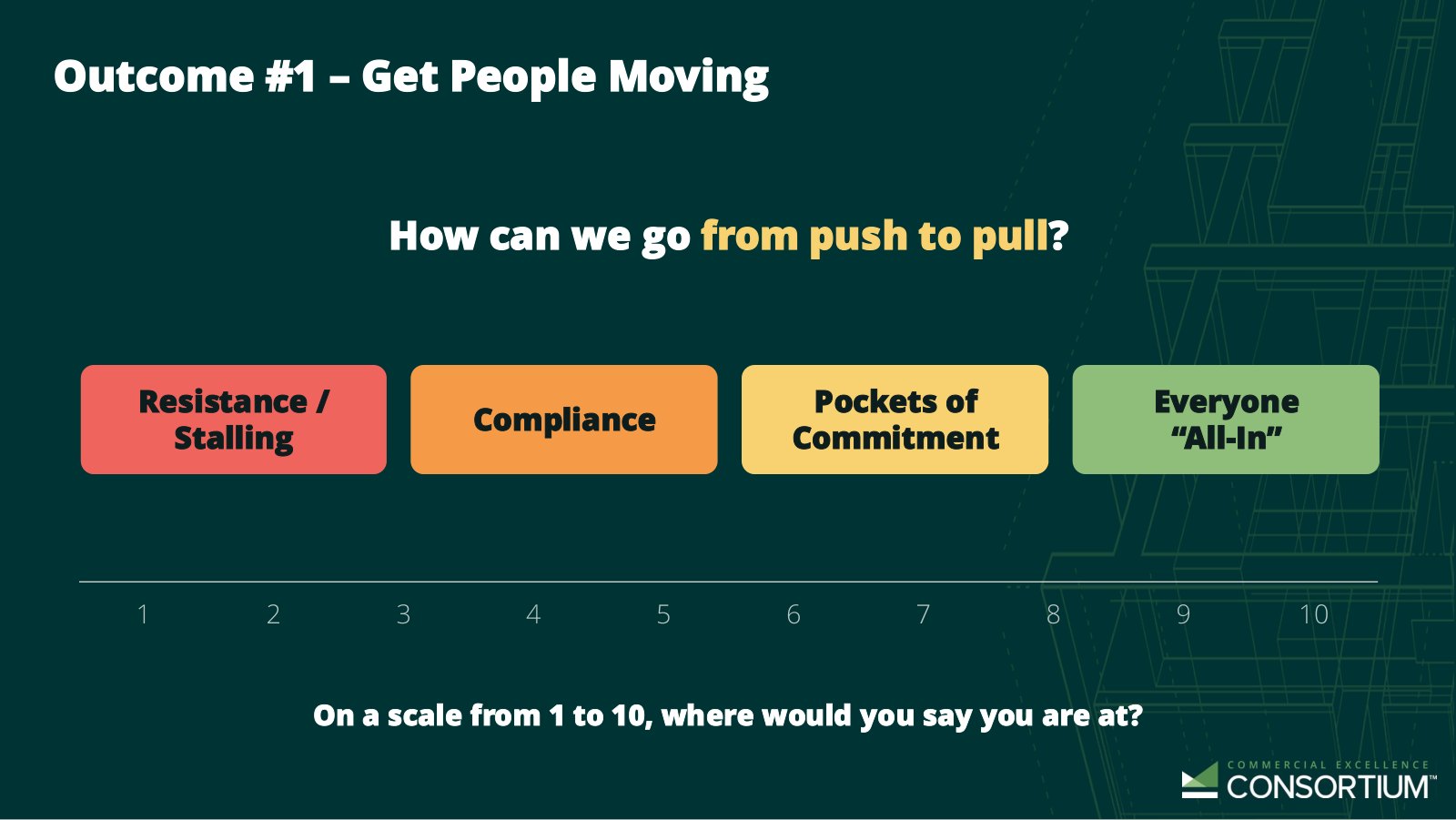
How do you go from push to pull? That is the question on the slide, and the middle of the slider is drawn to look bad on purpose, because the middle is where most programs stop and call it a win. Compliance is not a win. People fill in the fields and file the reports because they have to, and few of us do our best work that way. Pockets of commitment is where most big companies sit: a few real leaders pulling, a wide middle that is not fighting you and not moving either, and a long tail that has watched this come and go before. Only the far end, everyone all in, is the job done.
Asked where they sat, the room bunched up at six and seven, and the honest ones added that it swings around by business unit and by month. Nobody claimed the top. The room's own answer was control. Tell people what to do and you take theirs away. Once that is gone, so is the thing the whole change was counting on.
Highest response
8
Where the room clustered
7
Lowest response
5
Outcome two — strengthening the organization and its people
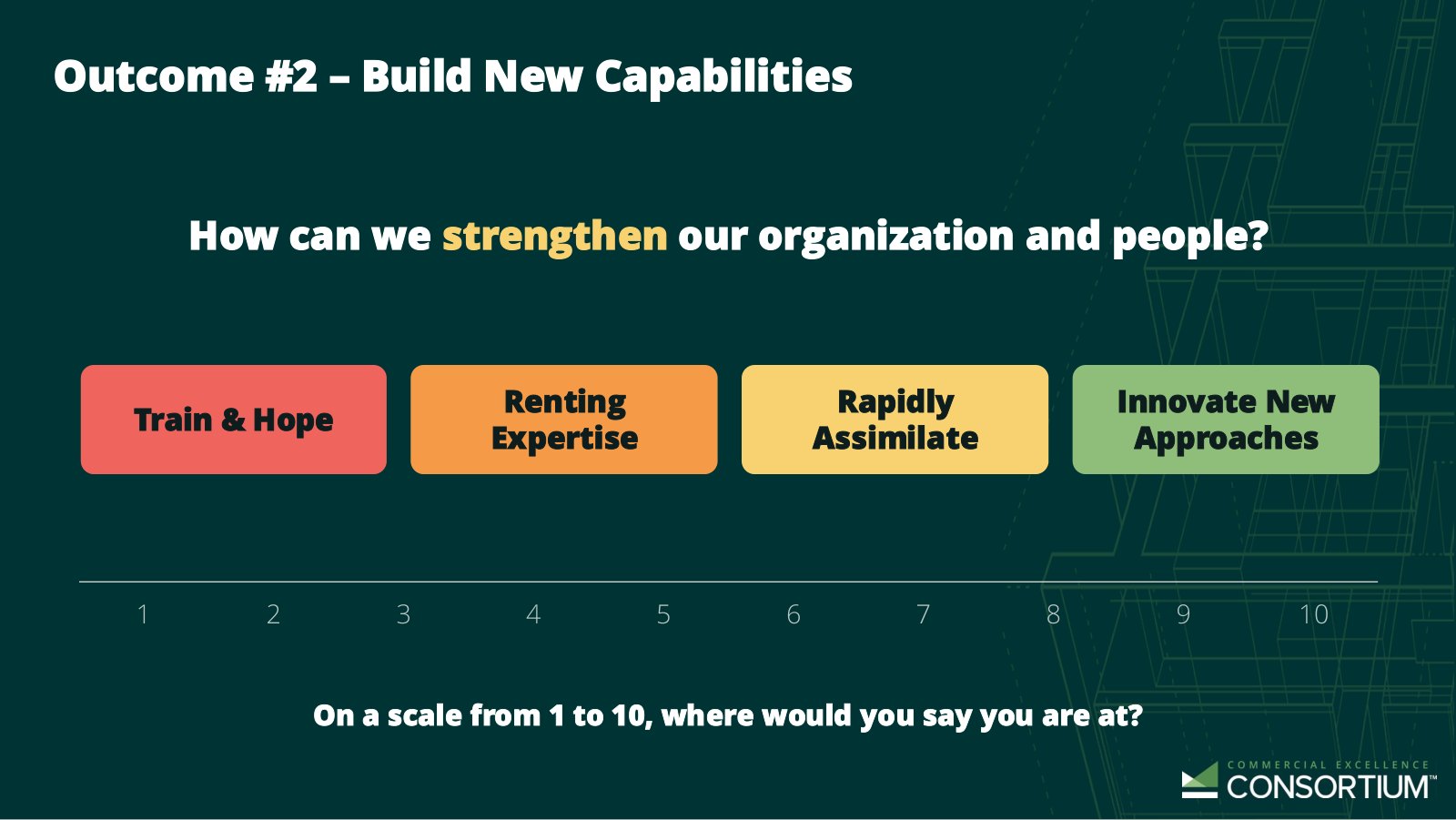
How do you make the company and the people in it stronger? The slider puts the most common answer, buying the skill in from a consultancy, near the bottom, one step above training people and hoping. Outside help is not the problem. Renting it is, because when the job ends it walks out the door. The next step up is picking it up fast and keeping it in the building. The far end is coming up with something new that the rest of the industry then copies. That is a different kind of win from learning somebody else's.
The room put itself at six to seven. We can pick things up, just not fast. One person described a two-hundred-billion-dollar private company that spends a lot on consulting and says out loud that it is buying the skill so it can learn it and keep it. Four things get in the way:
- 1
Culture and tenure
Where the boss is visibly behind it, the keen ones put their hand up and you can build on them. Where the boss is not, it never gets going. One person had run the numbers in their own company and found people who had been there under two years move much faster than the long-timers.
- 2
You cannot always look at the data
European privacy law stops you handing an employer the results for one named person, so finding the people who adapt well across a global business is genuinely hard. The same test used in the US to pick people for a startup program cannot be used that way in Europe.
- 3
No permission to be a beginner
Leaders rarely make it safe to get things wrong while you are learning, and harder still, to drop the habits that made you good in the first place. One person named the fear straight out: change means being a beginner again, level with someone half your age.
- 4
Everything at once
One thing at a time beats everything at once. Ask what you need, by when, and where you need it first. Start with a small group out in front and let it build. Forty-seven things running at once buys you nothing but meetings.
Two of those came straight from the room.
“If we take it from a global perspective, it's to do with culture, it's to do with how long people have been in the company, it's to do with the management roles. In countries where leadership starts to promote it, you get early adopters, and then you use the early adopters as ambassadors. What we struggle with is that we have very strong privacy laws, GDPR, so we are not able to go to individual level anymore to pinpoint the people who are really good at adapting.”
“An important point for me is how leaders create, or don't create, an environment where people are allowed to make mistakes and build new capabilities — but also to unlearn. We all want to learn, and we do not realize we also need to unlearn.”
Outcome three — converting the effort into new business
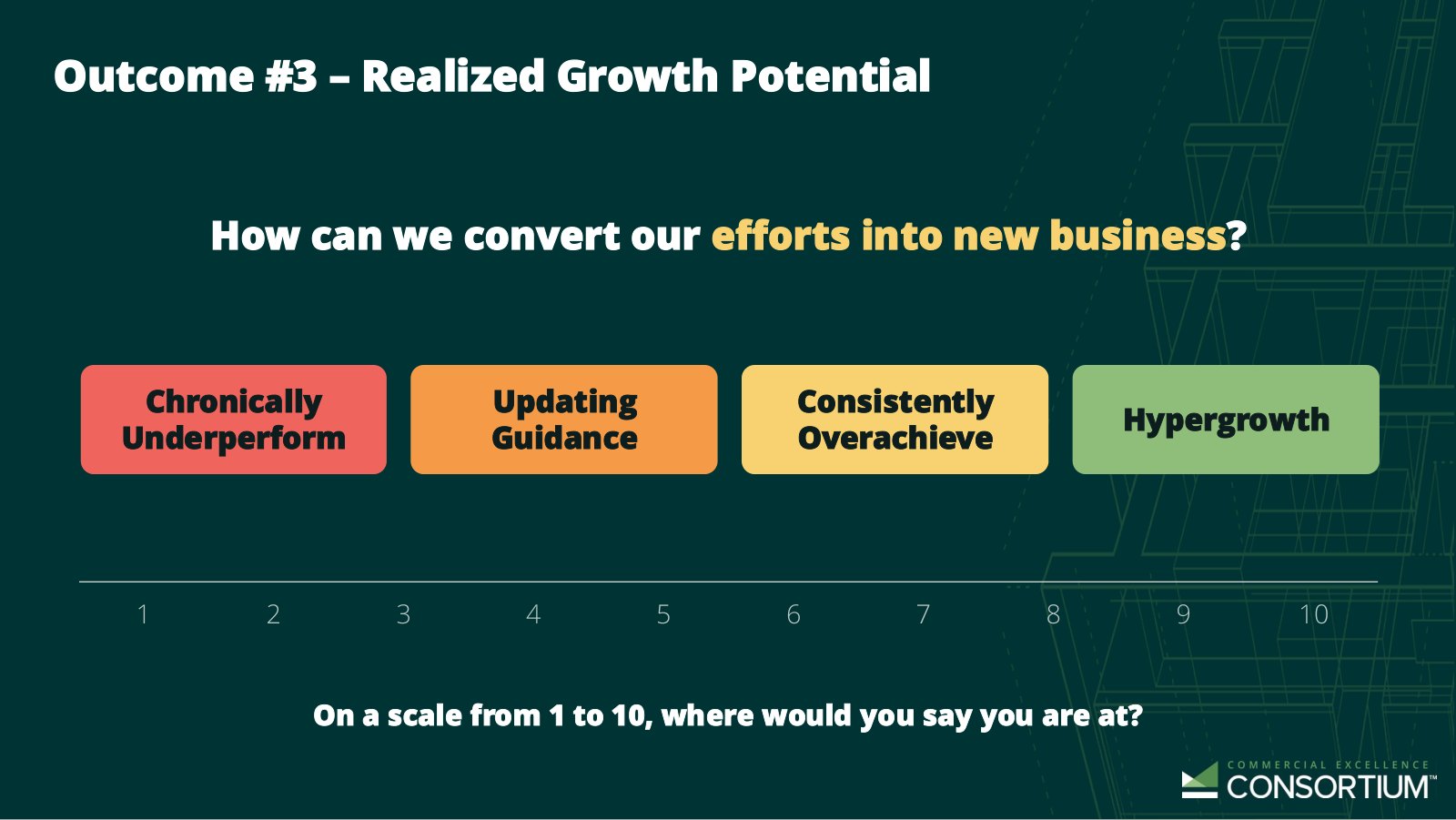
How do you turn the effort into new business? This is the only one of the three we did not ask the room to score, and the reason is the bind under it. Going back to the market to say you will miss the plan was described as close to normal among the companies in the room. But a commercial excellence team is not allowed to claim the number, so scoring yourself on it says almost nothing. The slider is still worth having. It shows you what this looks like when it is working, and the first two do not count for much if you never get here.
So how do you show the work paid for itself? The bind got named straight out, and it is a real one. You get judged on revenue and EBITDA you are not allowed to claim, and the business units who have to own the wins are the same people who get to hand you the blame when the numbers miss. They also have a fair case, because they were following a central plan while sitting in forty-six transformation meetings a month.
- The standard is contribution, not causation. Demonstrate that you might have contributed; let the P&L holders own the result.
- Look for leading indicators of whether people are moving. Not adoption scores and feedback surveys.
- The best evidence you get is not on a dashboard: a respected executive who has fought you for years telling the CEO, without being asked, that this one is different.
- Converting the skeptics with power and followership matters more than recruiting the people who sign up for everything.
The room got there on its own, in its own words
The most useful thing about this session is that we did not argue any of this. We asked questions and scored letters, and the answers came back carrying the argument. A supply-chain and transformation lead in appliances put the whole argument as a question, halfway through a conversation about motivation:
“Is it about willpower, or is it about designing the environment which then brings us all towards our destination?”
That is the whole thing. Adoption is something you push: we have decided this is right, now please use it. Adaptation is people becoming better able to respond, for reasons they understand and hold themselves. One is a mandate. The other is a set of conditions. And the room kept describing the second one without being led to it.
The same idea, from six different rooms
- A pricing leader in medical technology on why change feels like a threat: the third fear is that if we change, we become a beginner again, level with the twenty-five-year-old who has two years of experience. Loss of standing, not dislike of change.
- A data and AI executive in healthcare on what makes messaging land: the goal stays, but the approach is shaped by the people who have to make the change happen.
- A transformation director in pharma on the condition nobody sets up: whether leaders create an environment where people are allowed to make mistakes while building something new — and allowed to unlearn what made them successful.
- A commercial and growth leader in chemicals on why cohorts work or fail: it depends on whether people are allowed to have a failure and learn from it, or whether it is bolted onto the day job.
- A supply-chain transformation lead on what the Reflect stage really is: a first step of participative co-creation. And on guard rails: they give orientation and still leave room for co-design.
- A commercial excellence lead at a global electrical company on the most common own goal: we bring too many burning platforms at once and overwhelm the message.
None of those people work together. Several had never met. They landed in the same place from six different industries, and that is worth more than any framework we could have put up. That is not us claiming how change works. That is six people telling you what they watched happen.
“From my experience, it is not about the number or the percentage, but the credibility of seeing peers moving. Two credible colleagues talking about why they believe the change is good is far more powerful than twenty town halls and communication decks.”
“You don't need to jump on the bandwagon and try to proliferate the change all at one time. Take it in small bites. Use a cohort approach where you enable a small group, and then give them enough time to have that momentum. And the third point is it's all about patience, folks.”
“Whenever there's a leadership change coming in, I go into the smaller cohorts and identify those one or two people who will start being your champions, so that you are not the only voice in the room. Then it's: oh, that person who's in my job is talking positively about it.”
AIRAS — the answer put to the room
Our method, which Roy van Griensven has now run at LANXESS through seven rounds. He took the second half of the session through it as one worked answer to the gap the room had described, not as the general solution.
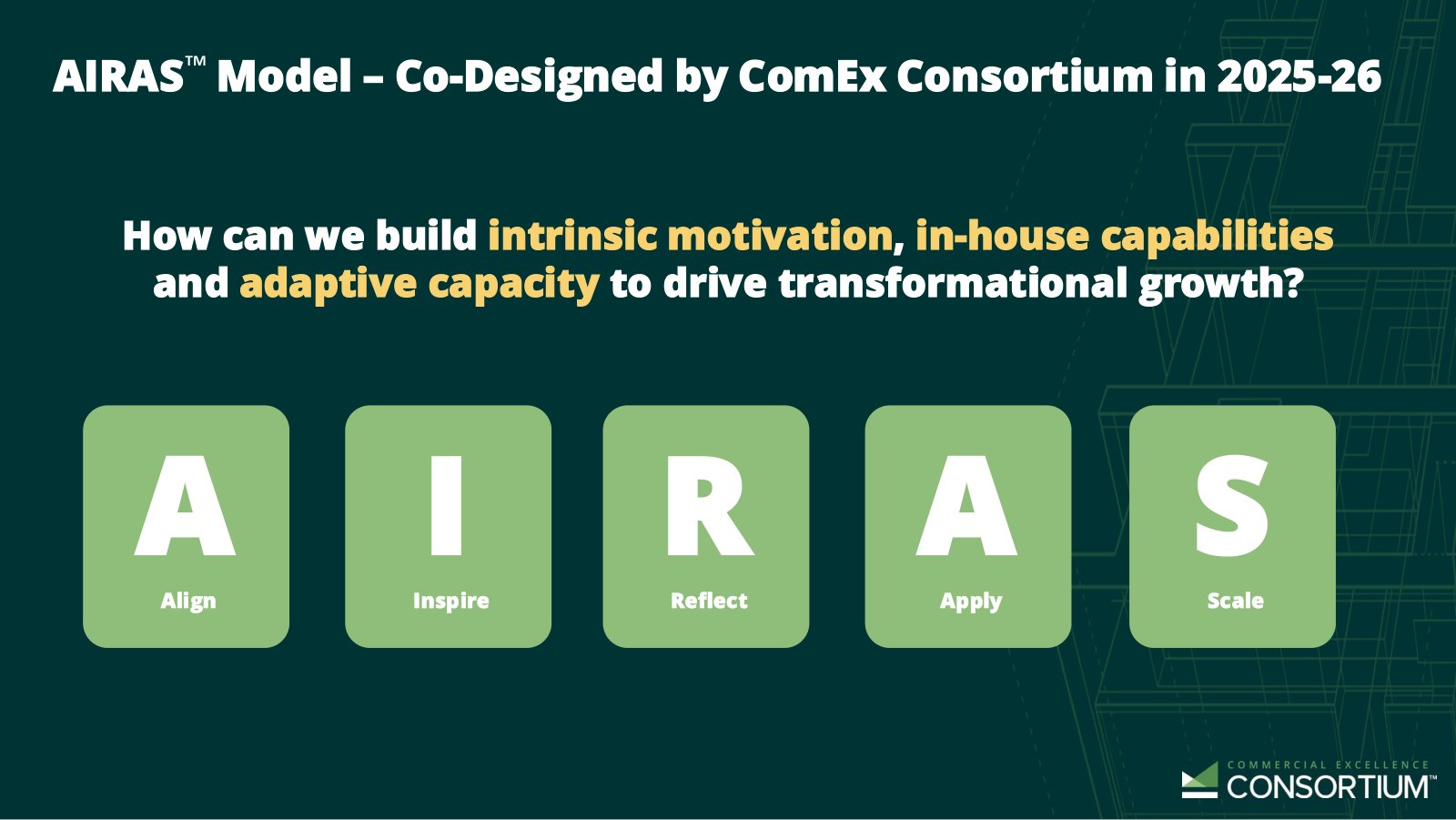
- 1
Align — improve or transform?
Run every improvement project you already have, perfectly. Does the gap close? Roy's answer was no. Agreeing to that meant stopping most of what was running and cutting outside consulting spend by about eighty percent.
- 2
Inspire — honor the past, then show the shift
Show how other companies facing the same shift responded, and stop there. In Roy's words: no judgement, no forcing people to do anything, just inspire. Give examples. This is guided discovery.
- 3
Reflect — ask the people who will be changed
Cohorts of about thirty, in a room safe enough to say what you think, asked one question: what is the one thing that would let you do your job better than before? Structured autonomy keeps it inside the boundaries Align set.
- 4
Apply — ninety days on the real job
Ninety days of coaching on the one thing they picked, on the real job, instead of two days in a classroom. Tools arrive when asked for. At the end they present to a senior committee that turns up to listen.
- 5
Scale — the stage nobody designed
It arrived on its own, carried by people telling each other, not by anything we sent out.
Two of those stages carry the weight, and Roy said why better than we could. On Reflect:
“Ask the people that are going to be subject of being changed how many times the company actually asked their opinion of how we need to do this. I dare to guarantee that more than ninety percent will say no. The typical way we do it is the consulting company came in, they built great slides, they were presented in the town hall, and then they were cascaded into the organization.”
And on the board conversation that has to happen before any of it starts:
“You need to have that dialogue with your board. If at the top of the company that deliberate discomfort is completely not possible, is not wanted, people are not open for that — forget it. Then it will not happen.”
“The CEO asked me, Roy, can you guarantee me that this approach will work? And no, I can't. I can tell you that by making the mistake of trying it the other way, and that didn't work, I have a stronger belief that we have a higher chance that this will work. And if it doesn't work, I'm okay if you fire me.”
The inversion
So how do you get people to ask you for the thing you were going to make them do anyway? Every group starts from a problem. No idea what the customer needs, no technical help, no time. And every group ends up in the same place: we need a proper way of doing this, a process, a tool. They land on CRM by themselves. Nobody rolled CRM out to them.
“We're now in the situation where we've got business units standing in line, asking when they can please be onboarded in CRM. In all honesty, this is the first time I've ever seen this in a company, in my career at least.”
They end up exactly where head office or a consultancy would have put them, and that is the bit people miss. The answer did not change. Only who got there did. A tool the users asked for does not need an adoption program, and the trust you bank in round one makes the next few changes far cheaper, including in the parts of the business that were most against it. On AI, the same company now has salespeople asking to stop running pilots and just scale it.
Practices to apply immediately
- Stop spending the budget on awareness. The room put it at 2 out of 10 for difficulty and wanting it at 9, and yet town halls, cascades and comms plans almost all go at the part nobody finds hard.
- Ask what people stand to lose, not what is in it for them. Standing, being good at the job, who they know and how much say they have. And a loss feels about twice as big as the same size win.
- Use ADKAR for one person or one team, and reach for something else above that. Push it across a whole company and you get a thousand separate cases to manage instead of one change.
- Settle improve or transform before anything else. If improving is genuinely enough, a systems rollout is the right answer. If it is not, no amount of good work later will close the gap.
- Let the field work out the problem before you design the fix. Ask people what would let them do their job better and they land where you would have landed anyway, and then they ask you for it.
- Put the guard rails on the search, not on the answer. Leadership settles the destination in Align and the people doing the work own the diagnosis in Reflect. That is structured autonomy, and it is what keeps this from turning into a free-for-all.
- Stop counting how many people you have convinced and look at who they are. Somebody doing the same job as you, saying it helped them, does more than twenty town halls — because you believe them, and nobody believes a deck.
- Score yourself on all three at once, not one at a time. They are sliders, not lines to cross, and where you sit on all three together is what winning at work means. Then say you helped, do not say you caused it. Let the P&L owners take the wins, and watch for early signs that people are moving instead of adoption scores and feedback surveys.
Questions the room worked through
- Why do change programs fail even when everyone agrees the change is needed?
- Because agreeing is the easy part. Asked how hard each one is to pull off, on a scale where 1 is a walk in the park and 10 is near impossible, the room put getting people aware at 2 and keeping them wanting it at 9. Almost everything we build goes at the 2, whether that is town halls or cascades or comms plans. Someone put it better: getting people aware is easy, getting them to see it the same way is not. Someone else named the more common problem, which is too many burning platforms at once, so the message gets buried instead of landing.
- Is ADKAR still useful?
- The room said it is good but not the whole picture. It is a solid account of what has to be true for one person to change, and it gave everyone a shared language. What it does not tell you is why that so rarely happens across a few thousand people. Someone trained in the model said scaling it gave him “a thousand points of light to manage instead of an overall holistic transformation.” Several people now use it for one person or one team, and reach for something bigger above that.
- What drives resistance to change?
- What they think they will lose, not the change itself. The line that turned the conversation was that people do not ask what is in it for me. They ask what do I stand to lose, and what does this mean for me. Standing, being good at the job, who they know, how much say they have. And a loss feels about twice as big as the same size win. On sales projects the bad news lands first: more CRM admin, accounts handed to someone else, long before anyone sees an upside.
- How many people do you need to convince to move an organization?
- The room offered numbers, from thirty to forty percent on board to roughly one active practitioner for every thirty people. The best answer threw out the question. Roy van Griensven's view is that it is not the number or the percentage that moves people, it is the credibility of watching a peer move. Two credible colleagues explaining why they believe the change is good is far more powerful than twenty town halls and communication decks.
- How do you get people to ask for a CRM instead of resisting the rollout?
- Do not roll it out. At LANXESS they put thirty to forty of the people who would have to use it in a room and asked them what one thing would let them do their job better, and then gave them ninety days, a coach, and whatever tools they asked for. Every group started from a problem, like having no idea what the customer needs or no technical help to call on, and every group ended up in the same place, saying they needed a proper way of doing this, a process, a tool. Business units now line up to get on CRM. They landed exactly where head office would have put them anyway, and the only thing that changed is who got there first.
- What is the difference between improving and transforming, and why does it matter?
- It is the first question in the Align phase and the one most often skipped. Roy inherited a hundred-page consulting deck full of improvement projects. Run every one of them perfectly and the gap between where they were and where they had to be would still have been open. If improving really is enough, ADKAR and a systems rollout are probably right. If it is not, everything after it has to change, and getting this first question wrong sends the whole program off course.
- What is guided discovery?
- Asking the questions instead of delivering the answer, so people reach the insight themselves. It sits in the Inspire phase. You show how the world shifted and how companies in the same spot answered it, and then you stop. It points people at the right ground without telling them what to conclude. What keeps the later work inside the lines is structured autonomy, not guided discovery. The two get mixed up a lot.
- What is structured autonomy, and where does it sit in AIRAS?
- Leadership is clear about where this has to end up, sets the guard rails on purpose, and then lets people own how they get there. It runs across two stages. In Align, leadership settles what is not up for debate: the strategic direction, the business outcomes, the constraints, the economics. In Reflect, the people closest to the work own the diagnosis, the priorities and the experiments inside those boundaries. That split is what lets you ask a thousand people what should change without getting a thousand answers that do not fit together. Guided discovery is a different thing and belongs to Inspire.
- Why do two-day training rollouts fail to change behavior?
- Because knowing is not capability. The alternative described was ninety days of weekly coaching applied to the person's real job, from a coach who has done that job for decades in the same industry, with tools and playbooks turning up when people ask for them rather than because someone sent them. Most groups ask to keep going for another ninety days because it is visibly helping. Getting people in a classroom for two days and hoping something different happens afterward does not produce the same result.
- How do you prove commercial excellence contributed to growth?
- Do not say you caused it. The bind is real: a commercial excellence team gets judged on revenue and EBITDA it is not allowed to claim, while the business units who have to own the wins are the same people who get to hand you the blame when the numbers miss. What the room settled on is showing you helped, and watching for early signs that people are moving. The best evidence never shows up on a dashboard. It is a respected executive who has fought you for years telling the CEO, without being asked, that this one is different.
- Does AI make transformation harder to sell internally?
- It makes the deal feel more one-sided. Transformation is launched from the boardroom to raise revenue or cut cost, and felt at the front line as fewer people doing the same work. One person called it a raw deal: take part or lose your place, and even participating raises what is expected of you. He asked whether people can want it at all on those terms. A pharma leader described motivation falling weekly in a market where staff watch thousands of colleagues leave. The counter in the room was that the best operators are moving people into new work rather than cutting them. Nobody argued with the other half of it: what people see is what drives what they do, whatever anyone meant.
- What should you do about the people who resist?
- Two answers, and the room held both. Detractors are an asset: they name the pitfalls nobody else will, and sometimes they are telling you the change is not needed here at all, and almost nobody asks them that on purpose. And the people worth winning over are the powerful skeptics, not the enthusiasts. Anyone will sign up for the new thing. The ones who move a company are the executives people listen to. Get them saying something different in private and the rest follows.
- What does it mean to win at work in a transformation role?
- Getting three results, each one a slider and not a box you tick. Getting people moving, from resistance, through compliance and pockets of commitment, to everyone all in. Building the skill in house, from train-and-hope, through renting it, to picking it up fast and then coming up with something new. And turning the effort into growth, from missing the plan every year to beating it every year. Nobody sits at either end. Where you land on all three at once is the score, and that is the measure, not how well the change program was run.
- Why draw the outcomes as spectrums instead of targets?
- Because the middle is where most programs stop and call it a win, and a target would hide that. Compliance looks like adoption on a dashboard and is not the result. Renting the skill from a consultancy looks like capability and walks out when the job ends. Telling the market you will miss the plan is a polite way of missing the plan. Drawing each one as a range, from a bottom end nobody would defend to a top end hardly anyone reaches, shows you the distance and shows you which of the three is holding you back.
- Where should a transformation start geographically?
- LANXESS started in the Americas, where people were more open to something new and readier to say what they thought, to build first evidence. They then went straight back into Germany, the hardest room and the most skeptical middle managers, because the hard part has to be faced head on, and once those people start speaking well of it the rest gets easy. More than nine in ten of even that group came around.
Full transcript84min · speakers de-identified
I feel like it's a really fascinating and interesting topic, but I honestly believe like none of us are interested in the work we do like to have change be like the end in itself, right? Like, it's sort of we need to help people deal with change and get them to grow and learn, but it's very shallow in my opinion. I just think like when we talk about change management, we've got to like there's all this connotation with the language of what that means when we say those words. And I just think it's a pretty shallow concept.
My goal today with you guys is to go far deeper on this, about what we really are trying to accomplish in these roles, right? And to challenge some of the current thinking around, or not even current, older thinking on this idea of change management.
So, for those who have been classically trained, this is kind of review, right? We talk about stakeholder management, mapping, figuring out where the resistance is going to come from. We do a lot of communications planning. We do incentives or KPIs and carrots and sticks, right? We have training programs.
We do software rollouts. We have projects. We have comics. We have stuff we're going to throw at you.
You will do it. We're smart. We did a lot of research. We worked with the big consultants.
We got AdCart. We got models for this stuff, right? I'm a professional change manager. Well, I think that that's fine, but I think it leaves a lot on the table.
And I don't really think we care about being good at change management. I think we care about some deeper things.
So, who's all heard of ADKAR as a method? Just plug in yes or no in the chat. Can you guys just plug in ADKAR? Yes, no, maybe no. We talked about this. Yeah, absolutely.
Of culture is super important as an input and outcome. Yeah, absolutely. Okay. So, yeah, I'm thinking fiftyfifty, right?
So, what is ADKAR? For those who've sort of been around it, instead of me talking, I'll get you guys to sort of help me explain this. So, my understanding is ADKAR was developed in the 90s by a guy named Jeff Hiatt at Prosci. I think it's Prosci is how you pronounce it.
He wrote a book.
He was an engineer and he wanted to build like a systematic model for change and what must be true for an individual to change. And I think he got it right. Don't get me wrong, guys. I'm not criticizing ADKAR in any way, shape, or form. I think it gave language, a model, really advanced management theory a lot.
I think it was just not the full picture is my opinion on this thing. Okay?
So, the A in ADKAR. Does anybody want to take a crack at guessing what the A in ADKAR stands for? Or if you know it, just plug it into the chat. What would A stand for?
Anybody? Okay. Yeah — awareness. You're exactly right. So, by awareness, we're saying, do the people understand the need for the change?
Are they aware of the need for the change? I think we're really good at this. I mean, town halls and explaining that we're in this tough situation and things aren't the same, our environments change, we all know we got to change. I don't think this is really all that difficult.
What do you guys think? I mean, in awareness, is this something that you guys find is something that you have trouble with? On a scale of one to ten, let's just say, is awareness a difficult thing for you to achieve when you're trying to roll out some sort of new thing? I'm going to say, yeah, it's a two, right?
I mean, I'll give it like a two as well. Don't think it's I went backwards again. I keep going into my chat. So, isn't really the difficult thing.
If a ten is like impossible and a one is like, yeah, a walk in the park, like no problem, it's a foregone conclusion, a global head of commercial excellence in chemicals's saying, most companies do not do this very well. Well, I mean, you'd think it wouldn't be that difficult to explain why like make the case for at least, you know, like what's going on out there. Communicating, right?
Okay, okay. So, awareness is not difficult, but shared understanding is. Great point. Absolutely. So, the next one, right? The D. Who knows what the D in ADKAR stands for?
I know somebody is going to say the answer. Okay, perfect. So, desire, right.
Well, I love the idea of being in excellent physical condition. I want to be in good shape. I want to quit drinking alcohol entirely. I want to do a lot of things. I want to win gold medals. But just because I want something, it doesn't mean I got the discipline and consistency to achieve it.
Right? And so, where have you guys found or what's the level of difficulty in generating enough desire, right, to sustain someone's behavior through a bunch of difficulty associated with learning new things or going through difficult circumstances. Is this a two? To generate real solid intrinsic, not even just intrinsic motivation, I'm talking resolve, where people are not only committed, they're going to stick to their commitments even when they're tired, when they're sick, when it's raining outside, they're going to get out there and do what they got to do.
Let me hear this. I really want to know. If you guys have this nailed, mean, we're probably all wasting our time here on this call today. But my understanding, my feeling is that the desire and the motivation, it's not even enough if you get it, but you got to at least have that to start from.
So I'm going to say desire is probably like, for me, long term resolve, consistency to hit new habits every day, avoid bad habits, and be dialed in on what we need to get done at scale when you've got hundreds or thousands of people that are well, we look at the engagement scores in our surveys. We don't have A players in every single position out there. So, let's put some numbers on this. We lot of qualitative stuff coming in.
I'm going go and say, to me, generating enough intrinsic motivation and desire that's sustainable over the long haul for a tough slog of a transformation, I think that's an eight or a nine, personally.
a global head of commercial excellence in chemicals, we work together. I mean, people get a little excited at the beginning and it's sort of new and they join the workshops and you're like, hey, there's some real work here. We really got to do things differently and new things that we're not really good at. Can we sustain that desire? Can we stay motivated?
Oh, and Roy's point is great, right? Huge difference between the company's desire and the individual person's desire. Okay? All right, next one. Jesse, can we talk or are you just talking?
Sorry, go ahead.
Can we add comments or interrupt? Yeah, yeah absolutely.
If you guys want to jump in, I just want make sure we got the model straightened out but this of ADKAR's model, this is the letter I want to focus on.
Good call, but let's pause and talk about this one, okay, as a roundtable topic. So, what is difficult about building, igniting intrinsic motivation and desire and sustaining it in the long haul? And the other side of that question is, even if you can do that, is that really enough to get people to consistently perform at world class levels? Don, you go first. I want to hear from you.
Yeah, I'm going to actually jump on a comment from Roy, right? It's very, very different when a company is trying to do that or an individual. And it's, I think it's all about the individual. I mean, if you're a leader that is not optimistic, that doesn't drive change and just has to do it because you're not going to make it happen, right?
It becomes very, very personal and I think that's where you get success.
Yep, I agree. Okay, I wanna hear from everybody on this one. Let's do a round robin. Over to a senior director of go-to-market operations at a global telecom.
I think one of the challenges that I have with ADKAR and I was trained in it is it's really great for individual look at transformation, but it doesn't really scale the organizations very well.
Everywhere I try to scale it across an organization, I end up with one thousand points of light to manage instead of an overall holistic transformation. So I come back to Kotter and some of those for organizational transformation and ADKAR more around where individuals or teams at. I don't know if others have had that experience as well.
Definitely, definitely. Over to a global head of commercial excellence in chemicals.
I think about it from awareness and desire. So I put in the comment a lot of companies don't do it well. Don't tell them why are we doing this. And then when they do do it, they create this broad brush awareness.
And I think desire, the problem is they're not messaging to the individual.
To Roy's point, it's and then individuals get concerned about what's in it for me or what is the impact to me on this That's a better question.
It's not what's in it for me.
It's what do I have to lose by this Doctor.
What do have to lose? Doctor.
Does this change mean to me? That's what I think people go to first is we've lost right over their desire. We assume we can get it. And we don't recognize this cognitive bias that we focus about 2x on what we could lose in a given change than the upside. We're wired that way. Our brain is trying to protect us.
Over to a commercial excellence lead in global manufacturing.
And just to add on to that, a lot of the commercial excellence initiatives that I've driven are touching salespeople. And there's a little bit too much focus on the negative. Like, you know, I'm going to have to do more things in CRM or I'm going to have accounts taken from me and given to someone else. I think the turning point is the, whether it's broad brush or explaining the why getting people, you know, rallied around that, but then showing them the positive impact to them.
Right. And here's how that's going to help your SIPP. And here's also how it helps the company, but they really don't care about the company. They care about their own situation.
Right? And so you have to really put the positive in front of them because too many will immediately default to the negative.
I heard it yesterday on a call with a really great executive at a really great med tech company, and he said, No, no, no. Around here, people understand change is happening for you, not to you. And I was like, You guys have pulled that off like that culture? Like, wow.
Pass off to you guys? Like, that's unbelievable. If you don't actually experience this thing, this passive resistance kind of thing, or people being slightly afraid or negative about change, who are you hiring? I want to know your hiring principles because that's unbelievable.
Over to a VP of commercial operations for Europe in food manufacturing.
Just to build on what's already been said, people do really well at adapting when they know they have to change. If I know I have to change, I change. So it's really about creating the need. It goes back to the why, but we're really good at adapting.
Think about what you do. If you know the world's changing, you know you're going to lose your job, you do something. It's that incentive to change when companies want to change and do something better, that's when people struggle, because they don't see that need. It goes back to impact.
That's a really amazing point. It reminds me of a post I made actually this week. A friend of mine, he told me this one day because we'd always try to get into shape. And then we just didn't have the discipline to do it, right?
And so we were in our 20s, and we'd kind of get there, and then we'd fall off the wagon, and we'd try again. And we kept going down this path and he said, Look, every time I snap back and I get disciplined and focused and get in Monday morning and doing the workouts and doing the diet plan, he would say, At some point, it becomes more painful to stay the same than it does to change. And that's when we change. And I'd like, Oh, yeah, that's good point.
But when we're rolling out a project or a CRM, are people at that point, personally, do they see the need?
Oftentimes, they don't. So, a good point. If they can establish their own need, then it's easy. But how do we get people to arrive at their own needs? That there is a great question. Over to a chief operating officer at a global professional services firm.
I think it's becoming more and more of an unequal compact when you talk about trying to create desire, and AI is changing its balance even further than it was before, which is frankly a lot of times when we talk about transformation.
Transformations launched from the boardroom or c suite with very specific objectives of improving, increasing revenue, increasing throughput, reducing cost, often felt at the people level, whether that's they're expected to contribute more with the same amount of hours, or they know that there's going be fewer people trying to do the same job.
AI, I think, has actually really earned a reputation as being even more focused on taking out those jobs. So really, I think it becomes the unequal compact, which is it's either participate or lose your place in the company. And even if you participate, your place in the company is likely to have much higher expectations upon us. So I think this idea that saying that you can intrinsically find desire may be a false premise in many cases.
Well, it's a challenge certainly. That's for sure.
I mean, I got a guy who told me he's got to find a few million bucks in cost savings in his program.
Was like, just make sure they don't throw your salary on top when you're done and kick you out with it. Because that's kind of the job almost. It's, hey, figure out how to automate. I think that that's a really scarcity mentality approach to AI. I think AI is going to make the world 10x more productive. And I think we're still going to need human beings to do a lot of things. I don't think a lot of the best companies that are doing the best work with AI right now are strictly looking to use it to cut jobs.
They're redeploying people into new things, new value added activities. But I think there's a fear there, And the perception is all that really matters, right? It doesn't matter what the intentions of the company are. They can communicate it in the town halls.
But a chief operating officer at a global professional services firm, you know as well as I do, if I'm afraid and I want to believe what I want to believe about this, and I'm like, well, what do I really do around here? I used to be the guy that knew how to use the old legacy system and everyone came to me because they didn't know how the process worked. The new guys, I'd kind of get them going and onboarded. Well, what happens when that's all like in a database and they can just go ask the AI genie?
Like, my value to the company all of a sudden diminishes. And the truth is, it's true.
People are going to have to start adding value in new ways, certainly. Over to a VP of marketing and R&D in specialty chemicals.
Just a couple of points based upon the stripes I've run on my back over the years. First of all, everybody loves change. Change and growth. How often do you feel those two things which are constant variables, the way I define it, right?
And my experience has been everybody loves growth and a change. And so from an intent perspective, there's never a failure. It's it's the next step of the journey, how you execute the journey to get and push change is where I would say eight out of ten times, you know, it falls short of the desired intent. So anyway, that's one.
The other thing I just wanted to share is, I've done this a few times, and what I've learned is you don't need to do, each one of us, we don't need to do this yourself. You don't need to go jump on the bandwagon and try to proliferate the change message protocol process, whatever you have in place all at one time, take it in small bites. And I think if you use a cohort approach where you now enable a small group or subsets of the population within your organization, and then give them enough time to have that particular inertia and to have the momentum. You know, and the third point is it's all about patients, folks, you know, how, so anyway, just wanted to share some stuff on that.
Bang on. In fact, we're going go back to this idea of small cohorts picking work to do and all that when Roy tells his story. But patience and love and humility, I mean, are the things that are my keywords for this year. We can't help people and serve them if we don't take good care of ourselves and put ourselves in a position to really try to understand.
I think half the problem with this transformation failure stuff is you know, we're just so goals oriented.
A chief commercial officer in chemicals put it this way: until the world stops seeing more consumption, more consumption, more growth, growth, growth, growth as how we deal with success. We're never going to have a circular economy. We're just messed up in terms of consumption equals good. And that needs to change, I think, across all of civilization. But that's a bigger challenge. Over to an SVP of enterprise applications, data and AI in global medtech.
So kind of going back to the awareness and desire piece.
We can talk about awareness is different than understanding and desire is different than motivation, etcetera.
For me, look, I think everybody is incredibly used to change. I think if you asked all of us to really honestly say, can you do change? Have you succeeded at change? Do you think you know what change is?
Most of us would say, Yeah, I'm not expert, but I'm pretty good at it. I think the same is going to be true no matter how many execs you've got in a room. For me, what is the huge differentiator that is often forgotten up front. And I come very much from a tech background in data and AI.
And we've seen it again, through change over the years. What we did with data twenty years ago, it's very different to what we do now. For me, it's the trust. And I think that's the most forgotten element.
We can have this awareness, we can have this desire, but are we building coalitions? Are the right people in the room where it happens? And is that trust there even to create those small cohorts? Because when you create the cohorts, the trust, that's where you have AI sprawl or one hundred different data warehouses or whatever the change may be.
So for me, the biggest element in any change program is not the desire. The desire is there. We can put up the KPIs, I'll make this, I'll do this in working capital.
Maybe it's actually the desire, you think?
Mean, whatever. I don't know.
I think it is there. I think everybody knows that change is no longer a choice. Change is part of our ways of living, even in personal life and professional life.
I think in professional life, it's the trust that is the biggest missing element in my experience.
Okay. Well, and an SVP of enterprise applications, data and AI in global medtech, I mean, she's CIO, SVP of IT at world class companies, very, very, very solid technology professional.
I want to have a side conversation with you. I grew up in the IT analyst world, and to me, change management was an IT function. I was like, well, there's kind of an IT capability. I'm like, wait a minute.
Not. Want to be rolling out tools. Anyway, we can talk about that another time over our drinks sometime. Over to a head of group supply chain strategy and digital transformation in consumer appliances. I don't know your name, your iPhone on there.
So maybe after it, and then we've got a senior director of commercial excellence IT at a global industrial after. Over to a head of group supply chain strategy and digital transformation in consumer appliances.
Right. Yeah, so why do we want to create the desire? I think trust and I agree is the foundation to make everything happen. But then why do we awareness is important because there's a direction, there's a why.
I think this is why we communicate awareness. But the desire then is what do we really want to achieve with it? It's like intrinsic motivation. And then my question is, hey, is it about willpower or is it about designing the environment which then brings us all towards our destination?
I'll leave it here because I think that's very different.
No, it's not myself. Less about push and change, more about designing environments for adaptation to occur naturally. Literally couldn't have said it better. Thank you. for getting that on the transcript for the recap. I don't know your name, I'm sorry.
I lead commercial in pharmaceuticals, based in France.
I would like to add a couple of more probably dimensions. Number one, we are driving the change in the organization, the transformation. We are super motivated. It's our job, and we would like to make it happen.
But if we think about the people who observe that every day thousands of people in pharma are fired, that their job coming to these people. Yeah. And they are told that AI will resolve all these challenges and so on. So the motivation of people in the field or in the office, what I observe currently, is going down every day.
So people are very much concerned and even if we show them a carrot they see what's happening. Yes, and they are very much concerned. It's number one. And number two is question of culture.
I work in France.
French people hate any changes. Yes, by default change is something which do not talk to French people about changes. Yeah, they would like to keep people as it is, to keep things as it is. So these are two additional dimensions which I would like to bring. Thank you.
Yeah, I think that that's bang on. We can't assume we understand the mindset of the people that we're trying to help and trying to get to do their jobs better and do new ways of working.
And that's something super important, right? When they see their company just announcing major cost cutting, no matter what the changes are, it doesn't seem like it's going be good for me, right? Unless I'm designing the cost cuts, I'm not in the room. So are they talking about me when they're cost cutting? That's what's really going on in their mind. Over to a senior director of commercial excellence IT at a global industrial.
Hi, everybody. Good morning. I think I have two perspectives here. One is, again, everybody's talking about the why.
When you start talking the language of how it's going to impact, one thing which has really helped there is having champions.
What I typically do is whenever there was a leadership change which is coming in, I always go in into, again, the smaller cohorts as was mentioned, but identify those one or two people which will start being then your champions so that you are not the only voice in the room. They start talking your language too. What that does is everybody else like, you know, and they're similar roles to others. And then they'll be like, oh, that person who's in my job is talking positively about it. I have to really think before I say negative stuff because it makes sense. So I think those champions really helped.
But just one controversial point maybe it's like change is anyway is going to happen. So resisting change or saying that we don't want it, I think people are again, like when COVID happened, nobody wanted it. We still embraced ourselves and everybody started to learn. Right?
So I just feel that's a part of our job. We have to learn. And I'm in operations like change is the only constant for us. And it's tiring teams lose their motivation, but to think that I might get fired.
That's how we should train our people. You should build your brand so that no technology and no other person can take it away from you. You should have your own. And if you don't have those capabilities, I think now is the time to build them rather than be scared of one day something will come to me and it's gonna come.
The change is coming. You like it or not like it. And I think you can sell the vision. Like, just got a new leader and he's talking like changes, massive scale changes.
And the only reason we are all excited is he's done it before. He's like, I've been in a company thirty five years. I know it works, guys. Like, believe me, x y z reasons.
It's exciting. But of course, we know it's gonna bring maybe our jobs don't exist, which is which is fine. But then I think it's the preparedness. You can't be scared and be in your room and keep complaining.
Like if that's going to be the case, you are going to lose your job. So I think we have to start like, I don't know, I just feel like there's only so much you can do for people who don't want to change.
Has to be a desire to Okay, okay.
That's a great point. That's the controversial point right there. So who here I'm throw it back on you guys. You guys are the leaders.
You guys are supposed to know this stuff, be the experts of this stuff. In the chat right now, who here has studied on ChatGPT personal intrinsic motivation, the science of adaptability of human beings? Who's gone down the rabbit hole on that for an hour or two to just dig in like what makes people motivated? What makes people fear change?
What can we do to help them be adaptable and resilient and more consistent? Who's spent time, invested their own time to try to get this stuff? Anybody? I didn't until about two years ago.
So, I'm going to say recently, but not really before. And this is a challenge because I think it's on us. We can blame other people. That's the same argument as what a senior director of commercial excellence IT at a global industrial just said.
Well, it's **** ** me, I'm going to be a victim. Or I can be accountable and take ownership of this challenge and realize maybe I'm part of the problem. Maybe the way I'm doing it isn't the best way. And so, it looks like, yeah.
So, right after failing a few times. Okay, okay. So, people are looking into this stuff, right? So, I want to get back to this thing really quick because I want to get some data.
I want to capture some data from this group of people very quickly, and then we'll do another kind of breakout on some of the topics. So, I'm going to kind of skip through the ADKAR, the rest of it. The desire is really the big thing. Knowledge is, can we explain to you conceptually what needs to be different, right?
So, when we want to break down what is a key account plan, right? They have to have the knowledge of what we're talking about. Then they have to show that they have the ability to fill out the templates or build the strategy or use the software or flip the laundry or whatever the ability is. And lastly, they say you need reinforcement.
So, in your environment, people around you, metrics, KPIs, governance, environmental factors to reinforce the change. I don't think any of us disagree that these are important factors when real change is going happen to an individual.
But if this is all that was needed, I'm aware of I have high blood pressure. I want to get into shape. I know how to make a diet plan and a workout schedule. I can do it sometimes.
My wife is telling me stop eating fried food. Don't drink the beer. I'm being reinforced constantly. But do I walk around like a fitness model all the time?
Absolutely not. So to me, this is sort of necessary. This is what must happen. It's just not sufficient to diagnose why it doesn't happen.
It's not science. Science helps us understand the world based on correlations to things, right? And so, if we run into issues with sustained desire, or if we're experienced, we realize that world class people don't always have motivation, but they do stuff anyways.
Every Olympian, right, has trained while they were sick, right? Every goal better, whatever anyways, right? And so, the top people, they have this unwavering, I call it resolve, right? They want it so bad that they'll do it no matter what, even if they're not motivated all the time. They don't feel like it, right? So, I want to ask a question.
So, if we say change management is kind of superficial, surface level, first thing that the first outcome that I truly believe all of us need to master is the words that Roy told me one morning. I said, with all this work we're doing, just help me communicate this to everybody else. What is the value of this to you? And he said it real simple.
It was over breakfast. He's like three words, get people moving, right? He had this sensation that like the organization was stuck. It was like we have great ideas, we understand why we need to change.
But then when you talk about, well, what are we going to do? It's well, yeah, we would be doing that, but this, but that, right? There's always these reasons, these I don't want to call them excuses, but there's adversities, there's difficulties. It's not just so easy for what McKinsey said on paper for us to go do that.
They don't understand what we're really going through, right? Who's heard that? Is that fair to say? Like, we've all heard that people, they understand the need, they kind of conceptually understand what the plan is, but they kind of then start whether they say it vocally or just to each other at the water cooler, yeah, this ain't going to work out as well as the strategy says it's going to it's academically correct, but I don't think it's going to work here.
We've tried this before.
This is all the kind of common stuff. So, the real question is, how do we get people moving? How do we go from pushing change, pushing systems, pushing programs, pushing tools onto them, I think we all agreed just now that that sort of deflates intrinsic motivation. If you look at the science of that, you'll see autonomy is actually like the most important thing. And when we tell people what to do, we take their autonomy away. So, I look at this as four levels, okay?
Either when you're trying to get people moving, like a large group, call it five hundred or more commercial people, you've either got this like feeling of like resistance or they kind of say they're going to do it, then they kind of stall. Middle managers maybe stall or even GMs, whatever the thing is.
Or maybe you get to compliance. They're like, oh, fine. We'll fill in the fields. Okay, I'll do it.
I'll do the reporting. But they don't really want to be doing it. They're just kind of doing it because they have to be doing it. But you never get the best work out of people when they're complying.
Sometimes you get pockets. a senior director of commercial excellence IT at a global industrial, your point was find the champions. You got some pockets of real leaders that are like, no, you know what, we're going to go after this thing and we're to make it work. And you try to pull the other people along with you.
But you're still you know, you got these leaders that are adaptable that are trying to pull the other people with them. But the big middle of the bell curve, they're not those people. They're the ones that are the ones that are kind of more stuck, right? And then on the top end, and this is rare, is everybody's all in on this.
And we agree that none of us have everybody all in all the time on what we're trying to do. Or maybe a couple organizations here have that. I don't know. Like, are you guys in hyper growth?
Is anyone like Netflix or SpaceX or something where if you're not all in all the time, you're just fired. Our culture demands this. Very rare. So, the question I have for you guys, honestly, you don't have to put it in the chat.
Just think about this in your work.
And I know it's situationally dependent, depending on each program, depending on each BU, like whatever, each region. But like, are you trending toward dark green? Are you trending toward amber and yellow? You know, are you fives and sixes here, generally speaking, or nines and tens?
And I'm going ask you guys three questions. Not going to ask you well, you can throw it up there. If guys want to put it in the chat, be honest about it. I'm seeing sixes, sevens, pockets of commitment is kind of the norm, right?
But imagine if it were possible to actually get everybody all in most of the time. In order to do that, we to figure out a new way, right? All right. Next one.
So, get people moving. Second major outcome is we've got to build capability. Like if we change to me means market challenge, company response. If company response is new to compete and stay fit for that market condition in that place you play, you probably can't use the strategy and approach and skills and everything that you used before or it would still be working.
You wouldn't need to adapt. So, by needing to adapt to change, and usually it's external change, it forces the new capability development. You've all seen a strategy from the big consulting firms, there's about thirty to fifty usually on the list, right? It's in the three year rollout plan for upskilling.
Good luck, right? Too much stuff, way too many things, people being pulled in bunch of directions. So, what do we do? We do workshops, we do e learning, we try our best.
But at the end of the day, the question really is how can we strengthen our organization and our people?
And not just in technical skills, but to a senior director of commercial excellence IT at a global industrial's point, how do we get more champion type people just mindset wise? How do we invest in their adaptability in the first place? So, any new skill, anything that they got to take on, they just get better at absorbing. They're like, I never learned how to play badminton, but I played tennis.
So, I'm just going to do it until I'm going to suck for a while and then I'm going to be pretty good after a little while. Every high performer knows that you just need to kind of be bad at things for a bit and get a coach and practice. That's just how we do it. Not everyone does that, though.
So, again, four level scale, right? We've got on the low end, we train them, we hope for the best, right?
In the middle, we've got some cash. So, we'll buy some bodies. We'll rent some talent from the big firms and we'll kind of outsource this a little bit or we'll bring in some big guns to train and motivate people and all that. We're kind of renting or even you guys are kind of on rent to these companies, right?
We'll bring in a hero and they'll shake things up for us. But on the higher end, some organizations just seem to be able to rapidly assimilate new capabilities and have them stick in house. I was talking to a very large private agribusiness the other day and I said, you guys spent a lot of money on consulting. Like, do guys feel like you're depending on them?
He's like, absolutely not. In fact, we're cutting our consulting. We told everyone we're buying this expertise but it's on us because we're making this investment to learn it and do it and stick it. Like, that is the expectation here.
And they feel like they're doing a good job of that. Well, they're a two hundred billion dollars private company. They've done pretty well. That's why I'd say they can assimilate new capability as needed.
And then you got like the very top end, Companies and people that are making breakthroughs, they're actually innovating new ways of doing work and then sharing them with the world, real new best practices. That's sort of the top end. They're not even just looking at growth mindset, right? Look at other people's stuff and then kind of make it your own.
They're pushing the frontier. If you guys were to look around at this, okay, generally speaking, right, again, it's situationally dependent across giant enterprises. But are we running expertise and we're dependent? Are we training and hoping?
Are we rapidly assimilating most of the time with whatever the new things are, the new demands of the market? Or are we actually like generating stuff, publishing new books, new thought leadership out of our work that the rest of the industry can pick up and learn from? What would you guys say? If you had to peg it roughly, I'm going to say my organization personally, we're like a six.
We assimilate, but we don't do it all that rapidly is the way I would describe it. What do you guys think?
Yes, no, maybe so? I got nothing in the chat. You guys completely out of this? Yeah? Okay.
So, a director of business transformation in pharmaceuticals's got a seven. We got a seven here. So, pretty good, right? Now, let me ask you the question.
What's hard about this?
Why aren't organisations able to assimilate rapidly the new capabilities that they need to have and maintain them, get them to stick in house? What makes that difficult? I'd love to hear from some people we haven't heard from so far.
Anybody, Over to someone who had not spoken yet. What's hard about assimilating capabilities rapidly?
Because there's a lot of reasons, I would say. But if we take it from a global perspective, it's to do with culture, it's to do with, let's say, how long in the company, it's to do with, let's say, the management roles. There's so many different reasons that we can clearly see that in countries where already leadership starts to promote it, then you have some early adopters, then we can use the early adopters to become ambassadors. If you can have that cycle and you're able to really pinpoint those people quickly, then you can go fast. What we struggle with today is that because it's a lot of technology and because we have very strong privacy laws, GDPR, all these kinds of things, is that we are not able to go to individual level anymore to pinpoint people who say, okay, we're really good in adapting these kinds of tools.
And I can tell you this is a real struggle to go fast and find that group on a global level that you can really extrapolate Well, it's true.
We just assessed two thirty people at a company, and the European people, like, we can't show the results to the company.
Like, we know. We can tell you who they develop and who they probably they need a lot of actual like help, right, as people. But we can't tell the company. But in the U.
S, they use the same assessment that we used here to see who gets into the entrepreneurship program because the data says that people with high, it's called AQ, adversity quotient, deal with adversity well and positively. They see it as an opportunity, not a threat. They build successful businesses. If they don't, they can have the best idea in the world, but the minute they get challenges, difficulties, whatever, they fold.
And so, they're not going to invest in these kids if they don't have the mental toughness in order to pivot and to stay alive as an entrepreneur. So, a real challenge is we can't even look at the data sometimes. Okay, that's a really good one. What other challenges do we have around getting off dependency and outside support and help or rock star hero executives that can come and go and leave our organizations to actually strengthen the people that have been here a long time, they've gone through three or four rounds of management teams, and they're going to be there for the rest of their career maybe.
What's hard about getting those people stronger?
Go ahead. Yeah, thanks. I mean, a lot of things have been said already and what we just said totally makes sense. Also the talk about trust for me, an important point always is how leaders create or don't create an environment in which people are allowed to make mistakes and build new capabilities, but also at the time to unlearn stuff because we all want to learn, but we don't realize we also need to unlearn stuff and in that mistakes are being made as The second thing in my experience is it can be really helpful as leaders in an organization to ask the questions what capabilities do we need by when, but also where do we need them first?
So does it all need to happen at the same time or can we take a staggered approach? Can we even experiment with a group of front runners or racehorses or whatever I'd like to call them without disqualifying other people, but like who are in there, like who do have the natural curiosity to get started first and create that critical mass and share those experiences at the water cooler and at the coffee station with other people to create that critical mass of enthusiasm around the change. But it all will go south the moment people don't have enough clarity about the why we talked about that and the transparency of what is the price with a Z, but also what's the price with a C for themselves, right?
So, and then that again connects to the trust.
Yep, one hundred percent. I want to make sure we have enough time to hear from Roy. Roy's actually pioneered a method, a very practical he's Dutch, I'm Canadian, we're practical guys.
Theory and this stuff is fine, but if it doesn't work on Monday and there's no evidence and data to support that the theory is working, I don't have time for it is the truth.
But I want to turn things over to Roy. Give me one more second. I have one more question for the group. We'll do one more quick round and then I'm going to flip it to him to kind of show this model, okay?
Because there's a lot of recordings we've already done on podcasts and things where Roy's kind of broken this down. Like there's at least five or six hours there if you guys want to go deep on it. But I want to have the opportunity for you to ask him questions as he's relating tactically the specific things he's done to try to generate intrinsic motivation, invest and build the adaptive capacity of not just the already highly adaptable people. They're not your problem.
It's the guys in the middle that have been here for thirty years and are kind of camping out. And we would maybe call them complacent. But maybe they're just comfortable. Maybe they just don't like change.
They fear it. Maybe, you know, there's all kinds of reasons. But that's the group we need to move if we want to get really good results happening, right? So, one more question, and then we'll flip it to Roy.
So, the last one here is, if we say we need to generate top line growth, like really to be good in transformation, it's not about software implementations and adoption and feedback scores, right? Like, you will be judged on, you know, EBITDA and top line. And although we can't say the work we did directly caused this impact and result, nor can we claim it. The BUs, the P and L holders need to own those metrics.
We're in this weird position where we got to show that the investments that they're making in ComX and transformation are not just a straight up cost center, but we also can't take credit and compete with our audience that we're serving, right, where we do get wins, right? They need to own the wins. So what do we do to show leading indicators? How do we show that we're helping?
And I would say, well, maybe show pipeline. Well, no, that's marketing and sales need to own the pipeline development and growth, right? So as comics and as a central function, how do we justify our existence and not be in a place of what I call concentrated accountability where if the upside works and the company grows and the EBITDA grows, great, the business leaders get to take the credit. But if it fails, they get to blame you because you know what?
Maybe they're right. Because they just listened and tried to do the best they could with what you told them to do from a central point of view, from a change management adoption standpoint. They can hide behind that. They can say, Well, I wasn't overwhelmed with forty seven initiatives thrown at me all the time.
I'd maybe be able to do some work around here and get some sales. But I've got forty six meetings in my calendar this month for transformation. I just don't have time to work. I'm working on the business so much with these guys that I can't do my job.
That's a valid argument. And I think there's some truth to it. So, generating top line growth is ultimately, if we're gonna be winning, if we're gonna be successful, if we're gonna have our mandates expanded, we can't say that we caused it.
Roy taught me this. We need to demonstrate that we might have contributed to it.
And maybe there is a metric that we can use in our function to show that the organization has people moving.
But more importantly than that, the people themselves, the executives, the ones that are the, call them stubborn, the sticks in the mud, a lot of power, a lot of respect, a lot of authority, not really the guys that are jumping on your change initiative all the time, maybe even actually mining you behind your back to other senior leaders. If those guys, even the two or three that have a lot of clout, start talking to the CEO about, you know what, this guy's different.
And the way we're doing this is different. It's actually, I like this. I think this can work. That conversation, that little anecdotal conversation goes much further than any metrics or reports or dashboards or anything you want to show, right? And so Roy's going to talk a little bit about that. But at the end of the day, I look at it as a spectrum again, right?
Are you realizing the potential that McKinsey said your organization in some universe is capable of? Hypergrowth, very, very few companies are at that level. Consistently overachieving their targets, some of you definitely, right, have a history of exceeding targets regularly. Updating guidance, I feel like that's kind of the norm right now for most of my clients that I work with.
They're like, well, we kind of made the plan and we're not quite getting there. And so, we got to come clean with the market and the shareholders and tell them we're not going to hit. And then you got just and I don't know that underperforming is the word. The world has changed rapidly.
In In some places where you had a lineup of customers out the door and you're the market leader, other countries have caught up in technology, in quality, in distribution, in areas where Europe and North America were dominating chemicals for a long time.
Now, you've got competitors that actually are competing with strong offers. And we need to not just wait for orders to come in and farm. We got to get people out there hunting for business and winning it again. But we didn't need to before in a lot of cases.
A lot of these big industrial companies didn't really need to do a really proactive hunting type of culture, right? And so, if we look at this, I'm not gonna ask you guys where you're at. We can look at the reports, all that stuff. I just want you to keep it in the back of your mind, right?
If we're able to demonstrate correlation to better growth and anecdotally have executives that are normally really stubborn and kind of the ones that sink your battleship when it comes to your initiatives and sort of undermine you on the things you're trying to get done, you can get them converted, not the ones not the coalition, not the guys that are the easy ones. If you can get the hard ones that have power and followership converted, I would argue that that's more important than getting the guys that are always going to sign up for whatever the new thing is.
Know, everybody does that, right? If you want be a standout leader, you've got to get those guys and the hard guys, right? So, with that, if you can do these three things, get these outcomes, I call it winning at work, right? If you're unable to do those three things, get people moving, deep resolve and commitment to our goals and to showing up and doing our best no matter what, building in house capability rapidly or even making breakthroughs and generating, like in Roy's case here, new ways of working that the industry can use, and actually generating growth that probably wouldn't have otherwise happened, that's how we get promoted.
That's how we get to move forward in our career. If we fail to do these three things, we're looking for a new role. Maybe we stay lateral in the industry. We get a new job somewhere else, but we're not moving forward, right?
So, with that, Roy, I'm going to flip it to you.
We got this ARAS model. We got about thirty minutes for you to unpack it. Maybe Maybe we do a little bit of Q and A at each kind of stage of the model, and you can share a little story about briefly what the stage means, some of the tactical things that you did, and maybe just give everyone a little bit of context. I think a lot of people here have kind of heard some of your story from past roundtables, But walk us through this, right? You let me know when you want me to go ahead here. I'll start with the line.
Yeah. Thanks, Jesse. And maybe, let's say to to flip back also a little bit to why kind of this is different. I think for me a very fundamental thing to start with and I know that is it took me a couple of let's say, attempts in failing before kind of I understood.
I think that is a fundamental starting point in a company asking about what are we actually looking for? What are we trying to do?
And I'm just talking out of practical experience only now kind of entering in my current job. I said, well, you know, when I was asked kind of to take this role, my first question back is, what are we actually looking for? And that starts already with the alignment. What are we actually trying to do?
Are we trying to improve our way of working? Because I when I was asked to to take this role and join you know the LANXESS Chemical Company of course German based tough dynamics you know all kind of pressure.
What are we trying to do?
And I was throwing kind of all these different reasons where I said, yeah, you know, we need to use more digital, we need to get our systems in order.
But that sounds for me a lot of improvement activities. So a lot of projects were installed. We got this whole kind of consulting company that built a deck with one hundred pages of all the things they can do.
But actually materially what was set out as a plan was a whole set of improvement projects. And my genuine question was that can be okay if we're trying to improve what we do today.
But if I look at the ambition of where we perform today and where we need to be at, in all honesty, I don't think we're gonna get anywhere close with improvement. Even if we do the sum of all these improvement projects together, we do them right.
We're not even going to get close.
So what is it that we're trying to do? Are we trying to improve?
Or do we need to transform?
And that's fundamentally different, very different.
So if the starting point in the alignment of what it, what, what, what as a company we're trying to achieve, if that starting point in, in alignment is already fundamentally wrong, then everything else beyond that is just going to completely run kind of off track.
And that is important, right? If we believe that improvement is enough, then probably a lot of the things that we typically do through ADKAR, through implementing systems and updating and digitizing process is probably the right approach. And that's okay.
If the belief in the company is and if the understanding is there that just improving what we do today is enough.
And then it's okay. If that's not enough, then you need to do something very fundamentally different.
Now, in our case, that was the case and the discussion with our CEO was it I I agree. We we we're not going to get anywhere close by just making a movement. We really need to fundamentally transform.
Okay, great. Super. That that sounds like a huge challenge, humongous task.
But then also how we do that will we will need to address kind of that we have an approach that that works with it. So if you go to the next one, Jesse, then, we said, if you go, let's say, take that alignment and you move from the A kind of to to the I and you need to fundamentally transform do people actually even know where we need to get to?
Right? And again I'll I'll use a very simple example in the chemical industry.
It's not about bad people, people that don't know how to do their job, but it's the circumstances have been very different. And I always use a very simple analogy.
In our company, in our industry, in the chemical industry, we've come from decades where if you open the front door, there was a queue of customers standing in line to buy product. So, the limitation was capacity.
Our assets were typically fully loaded. So what do you naturally need to do? Just pick the customers that you want to serve, focus internally of how you optimize the use of your asset, and with that increase your margin. That was the game.
Today, if you open the front door, maybe you see one or two customers walking around but it's by far not enough to be able to load the assets and with that, of course, the cost go up. So, actually, instead of turning around optimizing your asset, we need to go out the front door and find new customers. And that's something that typically the company and the people in the company had never had to do before.
So how can you get people to do something that they simply have not been exposed to?
And that's why we said, we first, before we're going to throw all kind of new tools and new KPIs and etcetera, you need to inspire a bit with examples of how other companies have done that before and that's where we said the inspire phase. We're not telling people how to do their job. We're not going to say, look, here is a new process and now just comply.
We just keep give people inspiration and saying, look, you know, some other industries, some other companies have had this challenge before and these are a couple of different ways of what they did to succeed.
No judgement, no forcing people to do anything, just inspire. Right? Give give examples.
The next step then becomes critical. And this is where there was fundamental discomfort at start.
And we did a little bit of a of a kind of a trick but we did a bit of that in the aligned phase already.
You need to have that dialogue with your board, with your senior leaders that if at the top of the company that deliberate discomfort is completely not possible, is not wanted, it people are not open for that, forget it.
Forget it, then it will not happen. But if there's any level of openness to then say let's look at what other companies have done in other industries. What what is needed?
And then you allow people to actually reflect on that and say hey what out of this can I actually use in my daily job?
To actually make it better, to actually help us transform, to actually make us get closer to the targets that we have and the goals that we have set out.
And that reflect is a way to do something that at least in the companies that I've worked before has never been done.
And that's asked the people what do you think that we need to do? What do you think?
How we can actually make that change?
And that's something that this is where, let's say the engagement and the change already start.
Because I dare to say, if you do in any company, you ask around and you ask the people that are gonna be subject of being changed and transformed.
And you ask them how many times did the company actually ask you for your opinion of how we need to do this?
I dare to guarantee that more than ninety percent will say no. The typical way we do it is the consulting company came in, they built great slides, they were presented in the town hall and then they were cascaded into the organization and we had to be part of adopting then the ways that were thought of and and the processes that were defined in the headquarter, the systems that were designed in the headquarter and they were rolled out to us.
That's typically what what what happened. At least that's my experience.
In reflect, and that's why I said it creates discomfort.
If you avoid that, if you avoid designing exactly how we're going to do all of that, But actually you ask people we all know that we need to transform, we need to change because we have a huge gap between where we are and where we need to be.
Now you guys help to co design what it is actually that we need to do and what you would need in order to be able to do your job better than before and how you can do that. And that's kind of the reflection. Now, we heard, let's say the wording in cohorts and groups of people and build coalition and build kind of this is what we have started to test. And when we started this, we also didn't know, we didn't have the guarantee. So the CEO also asked me, Roy, can you guarantee me that this approach will work? And no, I can't.
I can tell you that I strongly believe by making the mistake of trying the ADKAR way, you know, and that didn't work. I have a stronger belief that we have a higher chance that this will work. And if it doesn't work, I'm okay if you fire me. That's okay.
Right? But but at least we should give it a try.
And by that, we started creating cohorts where we brought actually commercial people together in small groups. We did the inspiration and we started asking them what is the one thing that if you are you get the freedom in a safe environment to actually build the one thing you would need in order to do your job better than before. And we give you ninety days and we give you the coaching, we give you the tools, we give you what you need in order to do that. What is the one thing that you would start with?
And then in groups of, let's say, thirty people typically in the safe environment, we started doing that. We've now been through seven cohorts of doing that. And the interesting thing is they all start with a problem, yeah, you know, I lack the visibility of what the customer needs and the connection, I don't get the technical people to help me and etcetera. The interesting thing is, they at the end all arrive at I need a systematic approach, a process, a tool.
But we don't start with we're gonna roll out CRM to you.
Right? But they all arrive at the point we need CRM.
The fundamental difference is it's not someone in the tower, it's not someone in the headquarter, it's not someone in a function that tells them you need CRM because we need to monitor your activity.
They came to the conclusion that what they need in order to to do their job to reach a target, there is a whole lot of things they can influence and in the end, to make that sustainable, they need a tool. So they're asking, so now whether the situation where we've got business units standing in line, asking when they can please be onboarded in CRM.
In all honesty, this is the first time I've ever seen this in a company, in my career at least.
So, we arrive at the same point. Of course, we need proper opportunity in pipeline management, we need a proper proper system, we need harmonized processes.
But the way to get there fundamentally different, because the people are already standing in line to ask for when can we actually jump on, when can we have it?
Now, if we then follow kind of the the different steps after the R then the next step comes the A and I hinted a little bit into that already.
It is the apply. Of course, by reflecting, by recognizing we need something, I have an idea. It doesn't it doesn't create a change yet. So, instead of designing a process, designing a system and doing these the typical massive training rollout where you get people in a room, having gone through a training for two days and then expecting that after the training they do something different. We tried a different model. We said, let's give support and coaching over a ninety day period, where actually we help them apply the one thing that they said, this is what would help me most in being able to do my job better and differently than before. We give them ninety day support and coaching in applying that change day to day.
In most cases, we actually get the question, can we do another ninety days? Can we extend this? Because it's helping me. Yeah, sure. We can look at that and etcetera. But applying over a period of time on the job, so not getting people in a classroom to not to say, yeah, yeah, I got the slides, yeah, I ran through the system once and then hoping that something fundamentally different will happen.
Different approach is just applied in day to day work. Apply where people actually feel that it makes a difference.
And then the last step is once that is there, then we talk about scale.
And this is where, again, I hinted already a little bit of what we see happening.
And to be honest, the S and the whole model, it wasn't thought through in that way. When we started, we said the align, the inspire and the reflect, That's critical. We need to then apply kind of in day to day job. The interesting thing is the S is now automatically coming.
The scaling is automatically coming because we have like the example I mentioned on CRM, we use business units standing in line to say, hey, I've heard from my colleague, my peer that is actually already doing this, is telling me how easy and how beneficial it is. When can we go?
And that's where I think I made one of the comments: how many people do you need as a coalition? How many people do you need to have convinced?
You can do town halls, you can do PowerPoint slides, you can send the message of change as many times as you want. I don't think it moves the needle. What moves the needle is someone that is doing the same job as I'm doing, that's telling me how helpful it is to him or her.
That's creating evidence. That's creating credibility, because then people say: oh, okay, so you're doing the same job. You're telling me, you're actually giving me a very enthusiastic kind of pitch of how it's so different now and why it's helping you, damn, I also want that.
And that's creating and by now the scaling and again very honestly here, our problem today is not getting people motivated, it's actually dealing with the level of enthusiasm and managing expectations that we simply cannot do everything at the same time.
I'll give one more and then I'll I'll I'll I'll pause.
One more thing.
If I look at and don't tell anyone we don't have LANXESS as people here at the caller. Don't tell don't share that with with people in LANXESS but it's a bit of a toy and horse approach as well. And I think we all know probably in history the toy and horse support. So it's a way kind of to sneak things in.
By having people co design the one thing, asking them what do you think? Don't bring them. We've got it all figured out. You just need to comply. Give them the sense that they had the opportunity to actually be at the start of designing how we do the transformation. Based on their motivation, based on their input, say what is the one thing that matters most?
You build so much credibility that in the meantime now we've been able to move in several other topics where they say yeah, sure, sure. If you say that we need to do this, bring it on, you know, that motivate. So ninety five percent of the change is now much easier because the trust is already there. The people had the feeling already that, hey, the organization has asked us, they've listened to us. So the adaptability for other changes is massively easier by now.
And I don't want to offend anyone in the call if it's German, but certainly in German culture, by default for topics you raise, you first get forty reasons why it's impossible.
And you need to figure out everything to one hundred percent, because maybe there is one thing that we're missing.
We see the opposite today. Even in the German culture today, we get people that say, yeah, let's try. Yeah, great. Okay, yeah. The whole level of trust makes complete difference.
Roy, that's great. Thank you for sharing.
I know this is high level, guys. We didn't want to get into the tactics in the weeds on specifically how do you engineer these conditions, but we have that information as well. So, if you want to listen to like a breakdown of like this whole operating system, like the tools we use, all the rest of that, we're sharing this all basically with the consortium, right? And so, questions for Roy.
I know I've got a bunch myself, but I can talk to Roy another time. So, I want to hear what questions do you guys have about this model in terms of igniting intrinsic motivation, investing in the adaptability of the people intentionally, right? Like measuring it, providing coaching on it, giving them co diagnosis authority, making them the consultants, stopping. I mean, Roy, you didn't mention this earlier, but when you started in the align phase, correct me if I'm wrong, did you not tell the CEO you were going to cut the consulting budget by eighty percent and stop all the initiatives that were being thrown at the business, at least for a little bit, until you could go in and reset?
Yeah? Yeah. That's that's a pretty bold move. Right?
Yeah. I mean No. And and that that helped in the aligned phase kind of on that trade. We should try kind of a different approach of course there saying, hey, you know what?
I think we can stop. We were working with BCG. We stop them here. We save eighty percent of the cost you were expecting to get.
I will I will use twenty percent but in a different way. Of course that helps. If if a company is you know money is pouring down the ceiling then that might not be you know a great argument but if we're struggling for financials then yeah it it can help in convincing kind of to try a different approach.
You negotiated some leeway, some rope to hang yourself over three months to build some evidence in return for a major cost cut in doing the approach a more efficient way, basically, was the deal, right? Yeah. Okay. Over to a commercial excellence lead in global manufacturing.
Two things. In really large organizations, it can sometimes be difficult to go deep into the organization and reach the people who are going to be the the change makers, right? You know, if you can get them on board, then they're going to convince their colleagues in the same function, you should try this. So I'm curious in a large organization like LANXESS, how deep did you go? And And then my second question is, was there one thing that was a little bit different? Did you intentionally focus this on some of those long time folks that have maybe not by title, but just by longevity and respect of colleagues that have a lot of internal And was that the one thing that was different and made this successful?
Yeah. Maybe two parts to your first question.
What we did is first go as deep as possible into the organization because that is where most of the people are that say no one ever asked us. So we deliberately skipped the middle management and went all the way to the people that are actually in the commercial functions, actually doing the account manager, sales manager, the product managers to that level.
We did choose to be a little bit tactical from a regional perspective, where we said we want to show that this approach therefore starting in the Americas region is going to be easier than in the German region. So we started in the Americas because the receptiveness of something new and the openness to just share kind of opinion is a bit easier in Americas than in Germany. But after doing that first in Americas, we very quickly went back into Germany because we said what we need to face head on is the most difficult parts in the organization because if you can get them actually to start talking in a positive manner, then change is very easy.
So, after a bit of first evidence in Americas, we immediately went back into Germany and there we just invited, including the middle management that were very pessimistic, very skeptical. He said, guys, just come on in. And there he said that you don't convince everyone, but then I think more than ninety percent, even of the very pessimistic, skeptical people said, damn, yeah, this will work.
Well, it's kind of hard to argue or be skeptical with your own ideas.
Like the design of the whole cohort based approach was you guys define the problems, you guys define the needs, you guys define what's going to be hard about this, you guys form teams, you guys create projects, you guys work with a coach, and you guys present your case to senior leadership board on what needs to change, how do you argue?
All you can say is, I don't want to participate.
I think it's a waste of my That's a And maybe one thing to add on that, Jesse, because I can imagine that this might be a question.
There is one important element which actually is an important part of the inspire phase.
If you do, let's say the whole code is and if you let people define without any guardrails, you know, you run a risk of creating chaos, right? Because yeah, then they might come up with all the wrong ideas and etcetera. So, we build something in which which we called guided discovery in the in the inspire phase. If you do that careful with the right kind of direction, you give people already discovery in a direction where we say these are the typical topics that matter for companies like we are in the situation we are in as LANXESS and these are the typical topics that help these other companies succeed. So, you do frame a little bit the thinking in the direction that you want them to go. So, there is a bit of guided discovery, right? And and those are kind of the guardrails that it doesn't go completely outside.
I think that that was a bit of a gamble in in all honesty to see because we didn't have certainty that that would work.
But I think if we look at the outcome of the type of projects, the type of topics that people then came up with, that was exactly within Do you mind if I share them, Roy?
Can I show the list of the fifty projects? Is that okay? I don't want to okay. While he's talking, you guys are asking questions.
I'm to dig this up, and I'll throw it on the screen. You'll be shocked. You would think this is the ComX list of stuff to do. This is what the people chose to do.
It's literally shocking. I'll be right back with it.
Go ahead, a commercial leader in global pharmaceuticals, based in France.
a commercial leader in global pharmaceuticals, based in France.
My question, what was the age of the few force? Believe you work with few force is average age of the people in the group which you you were working with?
Average age, I would say, in total is probably forty five plus.
But the range is from, let's say, mid second half twenties to sixties. So, we have the whole spectrum but typically, the the average age is a bit and even there because we have such a large also German based population, It's quite typical male, German, middle aged, white man, educated, engineering background, so not the easiest, I would say, per se.
Do you notice a difference in the age groups, I would say, on the reaction people, on the readiness to adapt to the changes?
Yeah. And that's and again, I don't want to generalize. I don't want to put let's say over generalized perspective here but I would say culturally, Asia, Americas, easier to adopt to change than in Europe.
Male harder than female. Female typically more open and constructive to change.
Younger generation, so a bit kind of mid twenties to kind of early forties, more open to change.
That's in general what we saw. Yeah.
Can you guys see the list of projects up there? It's kind of small. It's kind of tiny. I can sort of try to zoom in a bit more, but I mean, look at these topics, though. Like, I was shocked. I mean, the one thing I'll say in my observation, I was involved in the first few of these to kind of help with the design, and then the team sort of took over.
But there was a lot of internal focus at the beginning. It was a lot of growth barriers. It was reasons we can't grow in performance. It was let's go build a dashboard.
Let's do a tool. Let's do something about how we work inside. And I was just thinking, guys, we're trying to drive growth here. I'm a sales guy.
Let's go out and get some business. Let's go talk to some customers and build some new applications.
And there wasn't like a lot in the first few cohorts, and I was nervous. I thought, how long is this program going to last if it's just picking on internal little dysfunctions? I think a collective group problem solving operating model thing is a good idea, but I wanted some revenue attached to this. I wanted to see that we got some wins out of this thing. And Roy, maybe you can talk a little bit about where the shift from internal focus to actually attacking the market and trying to realize the potentials. I know you guys had, in commercial excellence, identified a lot of white spaces before, flipped them over to people and wondered why they didn't achieve the results that were available to them. When did that turn happen from internal barriers to external opportunities, would you say?
Yeah, I think it naturally happened already in the cohorts because I think it's very human to first look at the barriers of and that was certainly in in the culture and the DNA of our company. It it's first looking at why things are not possible, right?
But by addressing it, by going through that, I think the teams itself very quickly realized, oh, there's a lot that I can do to actually take these barriers away and once these barriers are no longer there, what is then the opportunity that I have? What can I attack? And I think there the teams very quickly themselves started to identify, okay, now what does it open in terms of opportunities that we can actually address these wins to growth for the company?
Maybe one very specific topic I would like to highlight, I typically talk to quite some people also in other companies here.
AI, for example. AI is everywhere. Everyone talks about AI, doing use cases of course, right? I think no one is not dealing with it.
If I look at how easy it has now become to scale the use of AI in commercial functions, I could not have imagined how easy this would have gone. So, we've had our salespeople actually banging on the door asking, can we stop doing use cases?
Can we just scale this immediately now? And what they're asking for is we have seen the value of AI helping us to prepare what opportunity I need to go after. What opportunity I need to go hunt for. So then they're not even debating, I know better or yeah, is the data correct?
Because by the work that they've done, they have already seen that AI will will help them and they're now asking for, can we scale this faster? Can we do more? It's it's a different challenge, right? We can't even keep up now with giving them what they're asking for.
But the change management is is is least of my problem right now in this case. And you see that kind of with the adoption of AI.
Guys, up at the bottom of the hour. I really appreciate you guys for sticking this out for ninety minutes. I'm happy to stick around and answer more questions or share more. I could talk about this stuff all day. I find it fascinating. Roy, do you have a hard stop? Do you got to head out for a meeting?
Yeah, I need to step out. Unfortunately, I think if other questions I think Jesse if people want to stick around you know some of this to to answer as well but I'd be more than happy to connect offline or follow-up individually with with questions where needed.
Awesome. Thanks so much, Roy. I appreciate you coming out. I'm just going to wrap us up here, guys. We got two little things. Roy, feel free to jump to your next meeting or anybody else, of course, if you've got to go.
If you'd like to go a layer beneath the surface of what we talked about today, We're putting together something that we're calling the fellowship and the executive council.
It's a way to work with us. And Dr. Paul Stoltz, the inventor of adversity quotient, the world's leading expert in adaptability and resilience science. He was instrumental in designing and developing the program at LANXESS.
But it is beyond this kind of free consortium thing that we have going on. So, it's something that we're inviting about twenty companies to consider at this time. And if they want to join, that's great. If they decline, that's okay.
We'll replace them with another company in the list of companies. We can't work with like one hundred companies instantly. We're a small business. And so, for those that want to learn more and get some help, there's this thing called the fellowship.
So, can book a call with me if you're interested or I'll reach out to you. The other thing, though, just to go much deeper on what we talked about today, we've launched this new Commercial Excellence Consortium website, but I haven't told anybody. I've been working on this for like a year and I just haven't actually launched it. It's out.
I think there's a lot of great content on here now. We've got, I think, like twelve roundtables recorded and recaps, and I've been trying to train the AI on a lot of these concepts from all the roundtables, all these amazing executives. So I've taken the transcripts, and I got them all up there.
So you can watch old roundtables just to see what other topics were discussed. Then there's a master class section. If you go under the Insights tab, it's commercialexcellenceconsortium dot com. Under the Insights, the bottom one is Masterclass.
I just reported a video kind of breaking down the tactics of the method. So if you want to know like, well, how do we drive alignment? How do we get the forty five capabilities that BCG said we needed to get better at focused to three or four per business unit? There was a method for that, right?
We had to like figure out ways to do all this stuff. So I kind of break that down in the Transformation OS little video. And then there's a bunch of just like interview style podcast videos with me talking to Roy or me talking with Dr. Paul Stoltz or whatever.
So if you want to go deep, there's tons of content. I think there's like thirty infographics, a bunch of briefs, a bunch of videos there.
And I'd encourage you all to keep coming out, keep showing up to these roundtables. We all hopefully learned a lot today. There was all kinds of great advice, information, perspectives in the chat and verbally. I'll be capturing the chat notes, the transcript, and forming a new recap, and I'll send that out to everybody in the group.
We are getting to the point where the group size is getting bigger. I think we were manageable today, though. I mean, we didn't do the round of introductions I like to do, but how did you guys feel like it went? If you were to put in the chat, last thing I'll ask you, scale of one to ten, what did you guys think? Was this a good use of your time, is the question. Ten being, let's do one immediately again, and if not, give me some direct feedback. I'll be looking for critical feedback so we can make these better.
So, yeah, if you've got ideas, we're flexible. We want to co diagnose, co design along the way. So, with that, guys, I think we'll wrap for today. But yeah, more interactivity.
I agree. That's my biggest concern is we've got to get people talking more. So, I'll definitely design that into the next one. We'll get an invite out for the September one coming up.
If anyone has ideas for topics as well, shoot them to me over a direct message on LinkedIn. Anything you want to get the group, you know, debating and discussing, let me know. And if you've got friends, if you know other people that are general managers, heads of commercial, heads of transformation, heads of strategy in billion dollar companies, invite them to join us, right? We want to continue to grow the group and get more new faces in here.
So, the more people we have, more brains we can have working on the problems. So, with that, I really appreciate everyone's time today. Thank you for contributing your insights. And, we'll see you all at the next roundtable.
Want to be in the next session?
Consortium membership is invite-only and reviewed weekly. Directors and VPs of Commercial Excellence, Strategy, and Transformation at $1B+ enterprises.
No consultants, SaaS vendors, or service providers.
Request to Join